
Dentures in Mobile, AL — Full, Partial & Implant-Retained Options
If you need dentures in Mobile, AL — whether you're in Tillman's Corner, Theodore, Grand Bay, or Dauphin Island — Rabbit Creek Dental is close by and ready to help. Losing teeth changes everyday things: what you can eat, how you feel in front of people, the shape of your face over time. We offer full dentures, partials, and implant-retained options, and we take the time to get the fit right.
Replacing Missing Teeth Changes Everything
Missing teeth affect more than your smile. They can make eating difficult, change the way you speak, and cause remaining teeth to shift over time. At Rabbit Creek Dental, we offer several types of dentures and partials to fit your needs, your budget, and your lifestyle — and we take the time to make sure every set fits the way it should. If you're still weighing your options, it helps to understand what to know before getting dentures so you can come to your consultation with the right questions. Ready to get started? New patients are always welcome — we'll walk you through everything at your first visit.
Types of Dentures We Offer
Not every patient needs the same solution. We offer three types of dentures and partials so you can choose the option that fits your situation best.
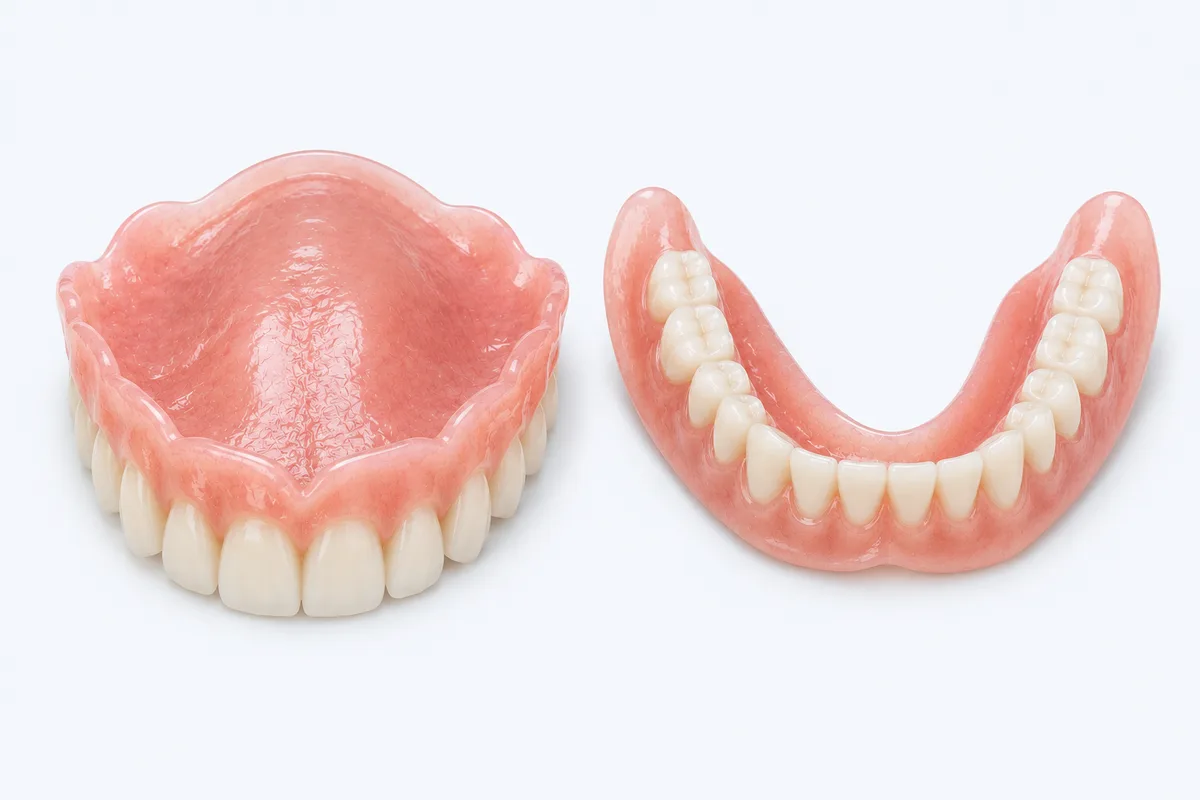
Complete Dentures
Complete dentures replace all of the teeth on the upper arch, lower arch, or both. They rest on the gum tissue and are held in place by suction and the natural shape of your mouth. Complete dentures are a time-tested, affordable solution for patients who have lost all or most of their teeth.
Best for: Patients missing all teeth on one or both arches
Partial Dentures
A partial denture replaces one or more missing teeth while your remaining natural teeth stay in place. We offer two types:
Flexible Partial — Made from a soft, pliable nylon material with no visible metal clasps. More comfortable for many patients and blends naturally with your gum tissue. A good fit for patients who prioritize aesthetics and comfort.
Cast Metal Partial — A rigid metal framework with a longer track record of durability. Metal clasps anchor to existing teeth for a stable, precise fit. The better choice when strength and longevity are the priority.
Both are removable and significantly more affordable than implants or bridges.
Best for: Patients missing several teeth who want a cost-effective, non-surgical solution.
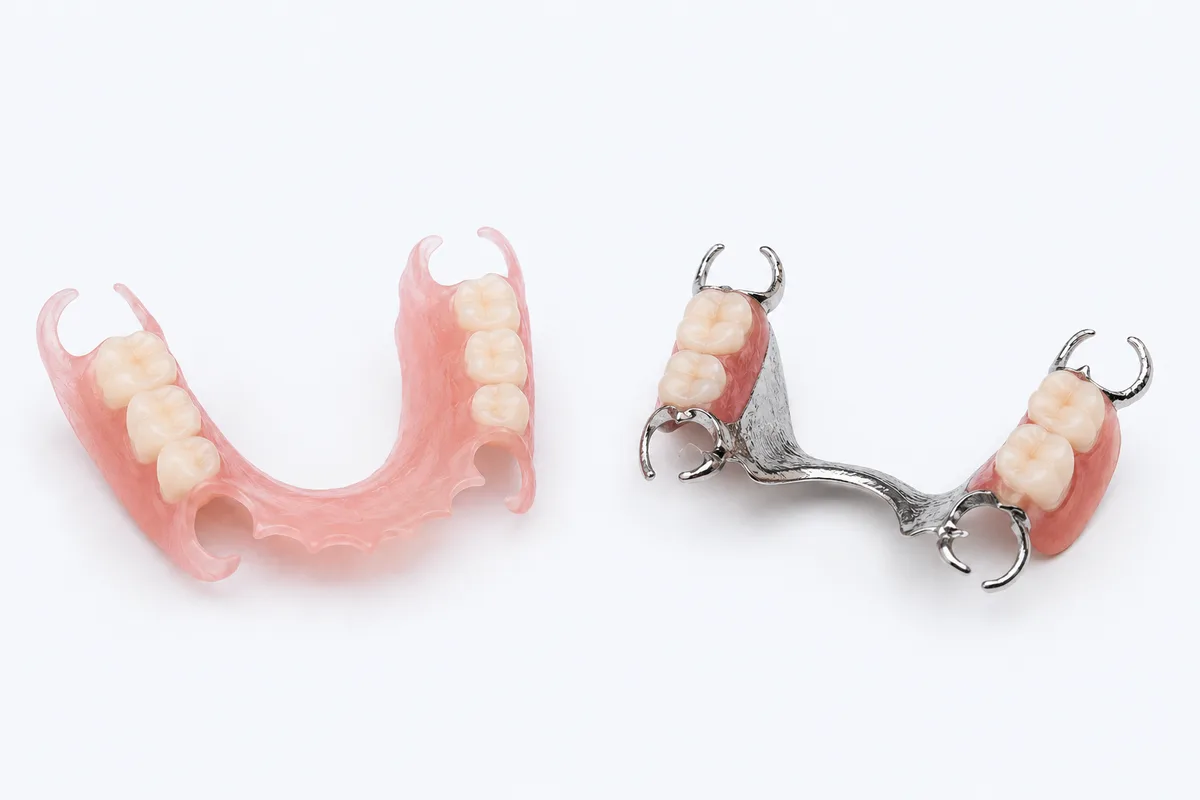
Left: flexible partial — no metal clasps. Right: cast metal partial — rigid metal framework.
Implant-Retained Dentures
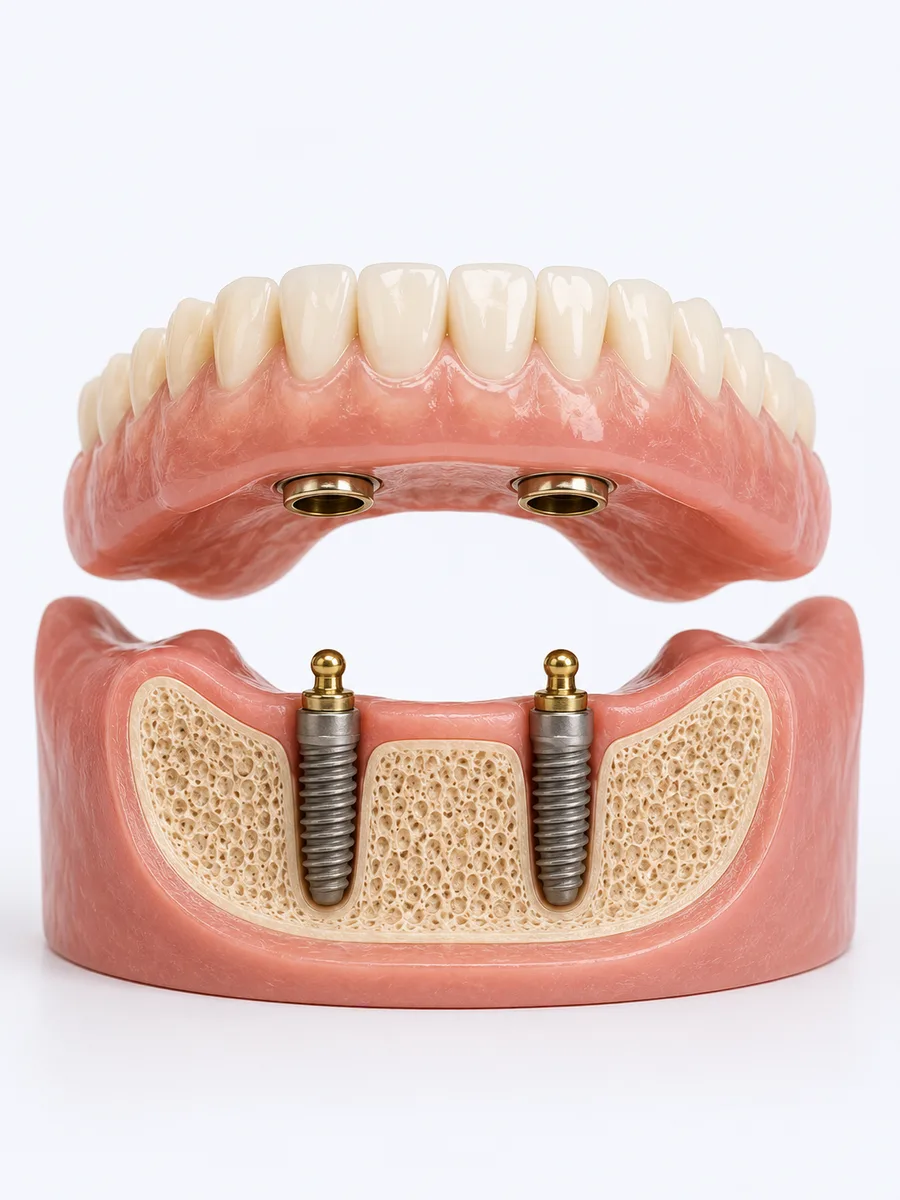
Implant-retained dentures are anchored to dental implants placed in the jawbone, which dramatically improves stability and prevents the bone loss that occurs with traditional dentures. They feel and function much closer to natural teeth — no slipping, no adhesives, and far more chewing power comparing tooth replacement options.
Best for: Patients who want the stability of implants with the coverage of a full denture
“ALL of the Staff were Amazing and SO Welcoming and Helpful.”
“My experience was Amazing and Wonderful. ALL of the Staff were Amazing and SO Welcoming and Helpful and such a joy to be with the Doctor as well.”— Christy P.
What to Expect: Your Denture Appointments
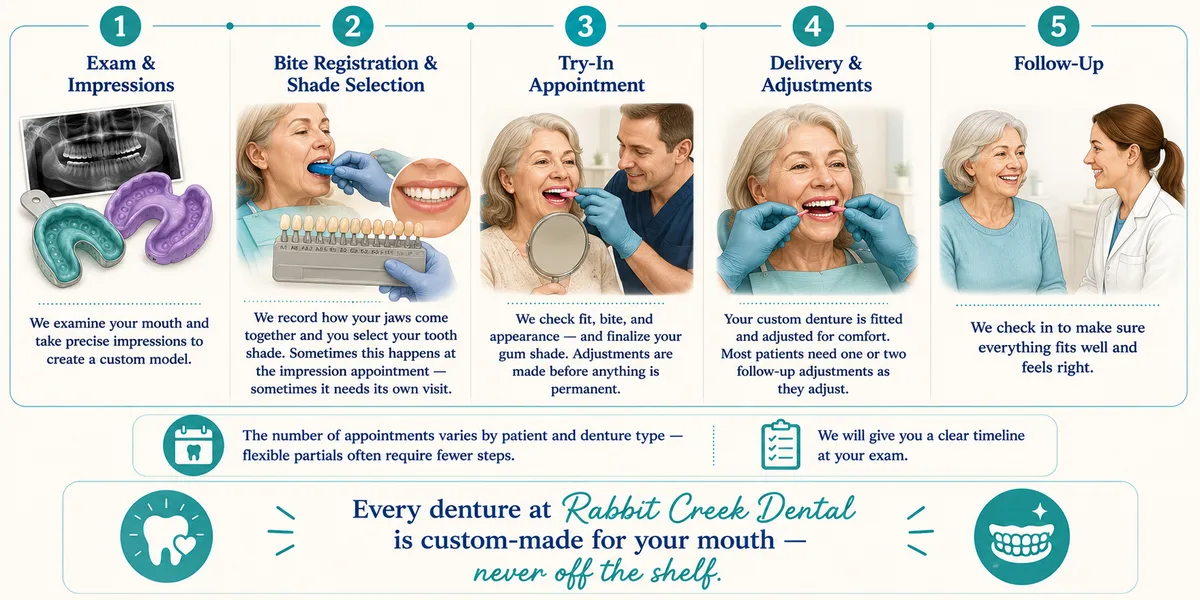
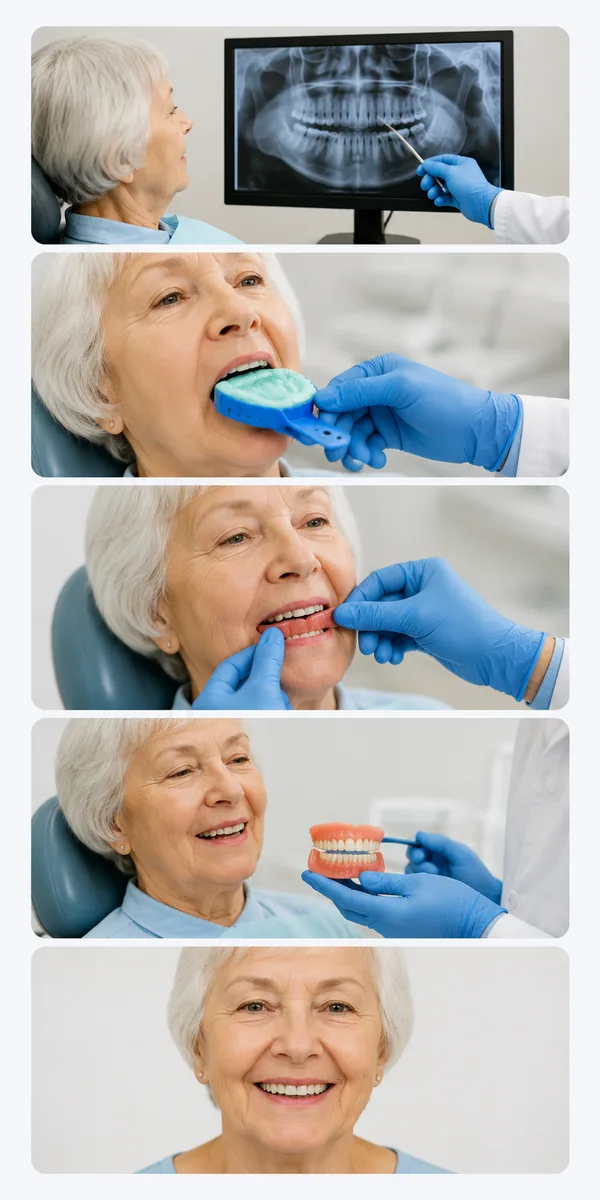
Every set of dentures at Rabbit Creek Dental is custom-made for your mouth. Here is a general overview of what the process looks like — your specific timeline may vary depending on which type of denture you are getting and your individual situation.
-
1
Exam & Treatment Planning
We start with a comprehensive exam to evaluate your remaining teeth, gum tissue, and bone. We will discuss your options, answer your questions, and create a plan that fits your goals and budget.
-
2
Impressions
We take detailed impressions of your mouth to create an accurate model for your custom denture. If you have enough remaining teeth, we may also capture your bite registration at this appointment.
-
3
Bite Registration (if needed)
For patients who do not have enough remaining teeth to record the bite during impressions, we schedule a separate appointment to capture how your upper and lower jaws come together. This step ensures your denture fits the way your mouth naturally closes.
-
4
Shade Selection
You will choose the shade of your replacement teeth and the color of the gum-colored material. We will guide you through the options and help you select something that looks natural and fits your appearance.
-
5
Try-In Appointment
Before your final denture is finished, we have you try in a wax model so we can check the fit, bite, and appearance. This is your chance to make adjustments before everything is finalized.
-
6
Delivery & Adjustments
Your finished denture is placed and we make any necessary adjustments for comfort and fit. Some patients need one or two follow-up visits as the mouth adjusts — this is completely normal and expected, and our guide to getting used to your new dentures walks you through what those first few weeks feel like.
The number of appointments required varies by patient and denture type. Flexible partials in particular may require fewer steps depending on how many teeth are being replaced. We will give you a clear timeline at your exam appointment.
Learn More About Dentures
What to expect before, during, and after — so you can make the right decision and adjust faster once you have them.
What to Know Before Getting Dentures
An honest look at what dentures can and can't do — traditional vs. immediate, adhesive, function, and setting the right expectations.
Read Article →Getting Used to Your New Dentures
New dentures take patience. Tips for speech, eating, soreness, adhesive, and cleaning to help you adjust faster.
Read Article →Removable Partial Dentures: What You Should Know
Cast metal, Duraflex, or resin? We compare the three options on fit, looks, durability, and cost.
Read Article →Caring for Your New Crown or Bridge
If your denture includes a bridge — what to expect after placement and how to protect it long-term.
Read Article →Frequently Asked Questions About Dentures
A full denture replaces all teeth on an arch. A partial denture replaces some missing teeth while your remaining natural teeth stay in place. Partials attach to existing teeth for stability.
For most patients, the process takes several appointments over 3-4 weeks. We take impressions, do fittings, make adjustments, and ensure the fit and bite are right before delivering the final denture. Rushing the process leads to poor fit and unhappy patients — we don't cut corners on that.
Modern dentures are designed to look very natural. You choose the shade of your teeth and gum color, and we work to select options that complement your face and appearance.
There is an adjustment period — most patients find eating easier within a few weeks as they get used to their new denture. Implant-retained dentures offer significantly better chewing function than traditional removable dentures.
There's usually an adjustment period of a few weeks. Your tongue and lips need to learn to work around the new appliance. Most patients adapt fully, though some sounds may take more practice than others. Reading aloud at home helps speed up the adjustment.
Remove and rinse dentures after eating. Brush them daily with a soft brush and denture cleaner — not regular toothpaste, which can be too abrasive. Soak them overnight to help them keep their shape.
We generally recommend removing dentures at night to give your gum tissue a rest and to soak the denture. We will give you specific guidance based on your situation.
Most dentures last 5 to 10 years with proper care. Over time your jawbone and gum tissue change shape, which can affect how your denture fits. We recommend periodic checkups to evaluate fit and make adjustments as needed.
Loose dentures are usually a sign that your jawbone has changed shape — which happens naturally over time after teeth are lost. A reline can sometimes restore a better fit by reshaping the tissue surface of the denture to match your current ridge. If a reline isn't enough, it may be time for a new denture. implant-supported dentures are also worth considering if looseness is a persistent problem.
Implant-supported dentures attach to dental implants placed in the jawbone, giving them a much more stable foundation than traditional dentures. They don't slip, they're more comfortable for eating and speaking, and they help slow down the bone loss that occurs under conventional dentures. They're a bigger investment upfront but many patients find them life-changing compared to traditional dentures.
We don't place full immediate dentures — meaning we don't extract all remaining teeth and deliver a full denture the same day. The reason is simple: immediate dentures are made before your mouth has healed, so they almost never fit well once swelling goes down and the bone remodels. Patients end up needing expensive relines or replacements quickly, and most are frustrated with the result. We'd rather take the time to do it right. For single tooth situations we may be able to provide something temporary, but for full or partial cases we wait for proper healing before taking final impressions.
Most plans cover dentures, but with significant restrictions. The most common limitation is a replacement clause — many plans cover a new denture only once every 5 years, and some have moved to every 8 years (96 months). Relines are sometimes covered, sometimes not, depending on your plan. We'll verify your benefits before starting so you know exactly what's covered and what isn't. Understanding these limits upfront avoids a lot of frustration later.
Honest answer: there's no comparison. Natural teeth are anchored in bone with a complex root and ligament system that gives you full biting force, stability, and sensation. Dentures rest on the gums and have maybe 5–10% of the functionality of natural teeth. Chewing is harder, certain foods become difficult or impossible, and the appliance moves. This isn't a reason to avoid dentures if you need them — they're far better than nothing — but it is why we take prevention, gum disease treatment, and saving teeth seriously whenever possible. Once teeth are gone, you're working with a fraction of what you had.
Ready to Explore Your Options?
Schedule a consultation at Rabbit Creek Dental and we will walk you through everything — no pressure, just honest answers.