
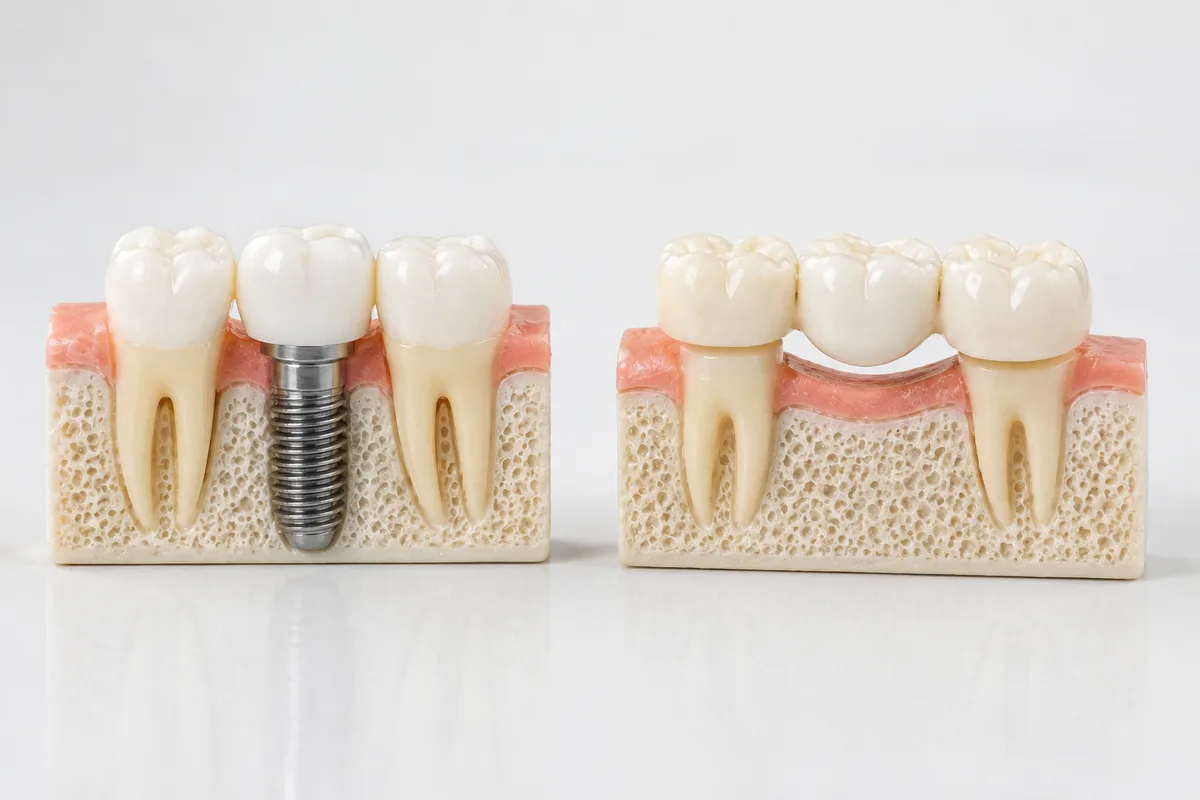
When a tooth is missing or needs to come out, most people in Mobile just want to know two things: what's it going to cost, and how long until it's fixed. Dental implants and bridges are both solid, time-tested answers to that problem — but they work differently, cost differently, and suit different situations. Here's what you need to know before you sit down for a consultation.
What Is a Dental Implant?
A dental implant is a small titanium post placed surgically into the jawbone to act as an artificial tooth root. Once the implant fuses with the bone over 3–6 months, a custom porcelain crown is attached on top. The result looks, feels, and functions like a natural tooth — and because it's anchored in the bone, it stimulates the jaw and prevents the bone loss that naturally follows tooth loss.
What Is a Dental Bridge?
A dental bridge spans the gap left by a missing tooth using crowns cemented onto the healthy teeth on either side, with an artificial tooth (called a pontic) suspended in between. Unlike an implant, a bridge doesn't require surgery or a multi-month healing period. However, it does require reducing the neighboring teeth to accept the supporting crowns — those teeth are permanently altered in the process.
How They Compare: Cost, Longevity, and Comfort
Implants typically cost more upfront but can last a lifetime with proper care. Bridges generally need replacement after 10–15 years. Both options look natural and function well for chewing and speaking. The key long-term difference: implants preserve the jawbone beneath them, while bridges do not — the underlying bone gradually shrinks when there's no root to stimulate it. Insurance often covers bridges more readily than implants, though coverage varies significantly by plan.
Who Is a Good Candidate for an Implant?
Most healthy adults are candidates for implants. The most important factor is adequate bone density — patients who have had a tooth missing for a long time may have experienced bone loss and could need a bone graft before placement. Uncontrolled diabetes and active smoking increase implant failure risk. A 3D CBCT scan at your consultation will reveal whether your bone structure supports implant placement.
When a Bridge Might Make More Sense
A bridge may be the better choice when the neighboring teeth already need crowns for other reasons, when bone density is insufficient for an implant, or when a patient prefers a shorter, surgery-free treatment process. For patients with insurance plans that cover bridges at a higher benefit level, the out-of-pocket difference can also be significant.
Making the Decision
The right choice depends on your bone health, overall health, budget, timeline, and whether neighboring teeth need restoration. There's no universal answer. The best approach is a thorough consultation — with 3D imaging to evaluate your bone structure — where you can review both options and ask every question you have before deciding. Visit our dental implants page to learn more about the process.
You can also learn more about dental bridges as a standalone option.
Ready to schedule your visit?
The Bottom Line
Both implants and bridges can restore a complete, functional smile. Implants are the longer-term investment; bridges are often faster and more accessible. At Rabbit Creek Dental in Tillman's Corner, we use 3D CBCT imaging at every implant consultation so you're not guessing about bone density — you're looking at your own jaw and making a decision based on what's actually there.

Dr. Joseph Gegzna, DMD is the founder and lead dentist at Rabbit Creek Dental in Mobile, Alabama. He earned his Doctor of Dental Medicine degree from the University of Louisville School of Dentistry and has been a licensed dentist in Alabama since 2014, with more than 12 years of experience in general, restorative, and implant dentistry. After several years practicing as an associate, he founded Rabbit Creek Dental in 2022 to build the kind of patient-first practice he believed in. He has completed advanced implant training through a 92-hour Implant Pathway program with live patient surgery and additional surgical training in impacted third molar extractions through the Koerner Center for Surgical Instruction. He is a member of the American Dental Association and is currently in his third year of the Bulletproof Dental Mastermind program, a continuing education group focused on delivering an exceptional patient experience. Before dentistry, Dr. Gegzna was a licensed pilot, bringing a calm, detail-oriented approach to patient care. Rabbit Creek Dental serves families throughout Mobile.
This article is for educational purposes only and does not constitute medical advice. For personalized guidance about your dental health, please contact our office at (251) 308-0584.
Questions? Call Rabbit Creek Dental at (251) 308-0584 — we're happy to help.
Frequently Asked Questions
Implants typically last longer — often decades or a lifetime with good care — because the titanium post fuses with your jawbone. Bridges usually last about 10 to 15 years and depend on the neighboring teeth, which can eventually wear or decay.
A bridge often has a lower upfront cost, while an implant usually costs more initially but can be more economical over time since it doesn’t need replacing as often and helps preserve the bone. We’ll give you a personalized estimate based on your specific case.
To place a traditional bridge, the two teeth on either side of the gap are filed down to hold the crowns — even if they’re perfectly healthy. An implant stands on its own and leaves the surrounding teeth untouched, which is one of its biggest advantages.
Most healthy adults are candidates, but an implant needs enough jawbone to anchor to. If bone has been lost, a graft may be needed first. Uncontrolled diabetes, smoking, and certain conditions can affect healing, so we evaluate all of this during your consultation.