
Dental Bridges in Mobile, AL
A missing tooth is not just a cosmetic problem. Left alone, the surrounding teeth shift, the bone shrinks, and your bite changes. A bridge fills the gap before any of that has a chance to happen.
“They gave me different options on how to fix my problem. I believe I made the right choice.”
“The whole office was warm and friendly. The staff was very helpful in giving me different opinions on how to fix my problem. I believe I made the right choice.”— Anita S.
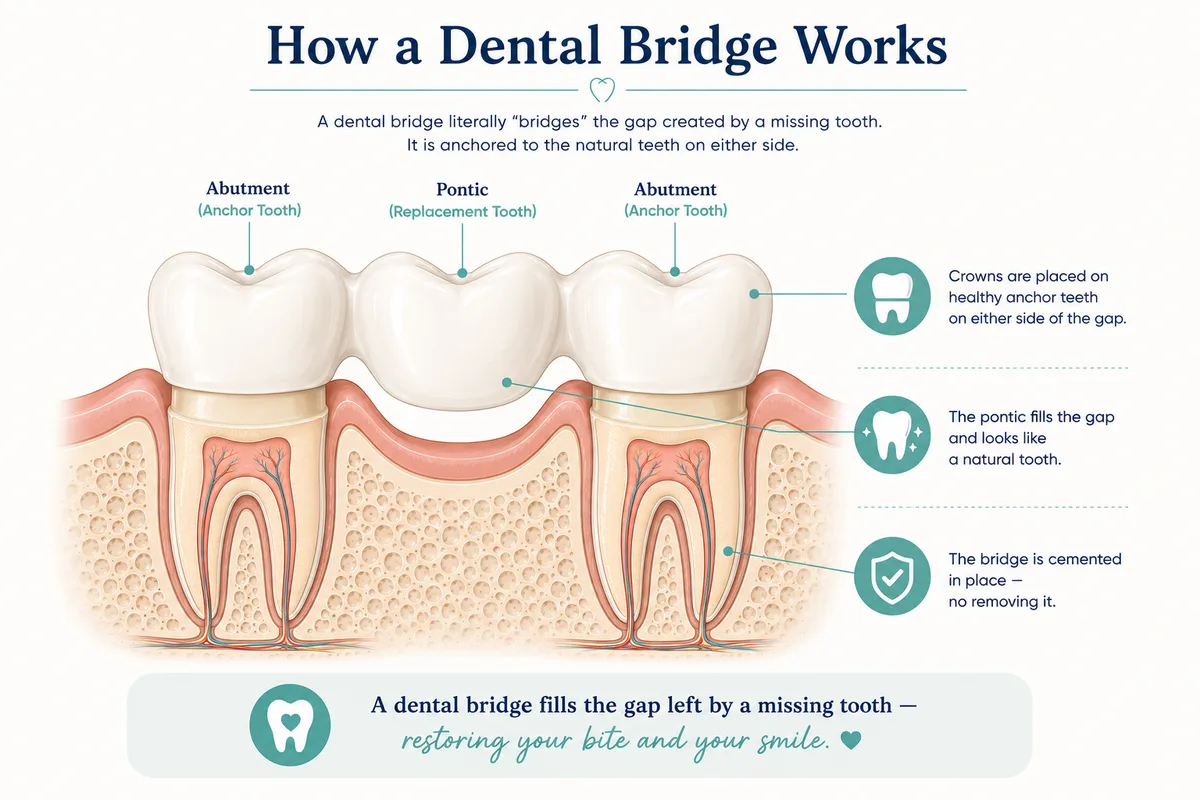
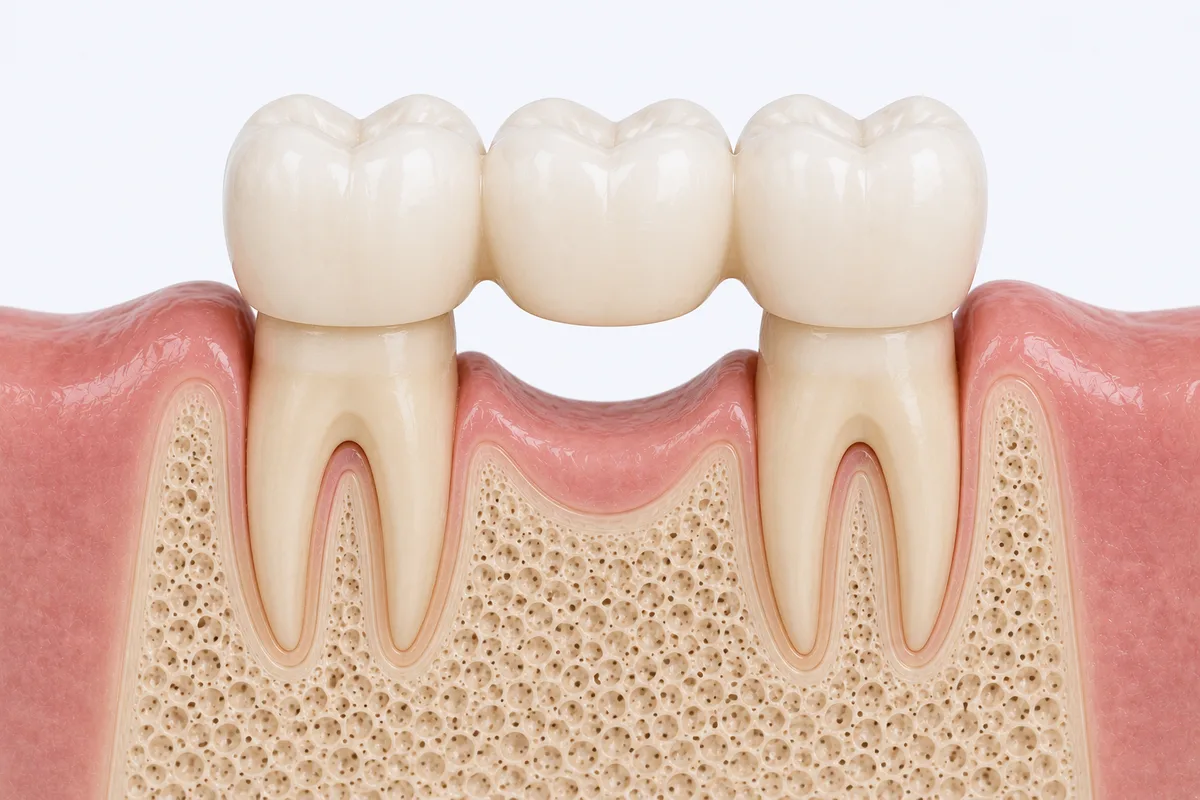
A bridge spans the gap — two crowned anchors hold a false tooth in place.
What Is a Dental Bridge?
A dental bridge is a fixed restoration that fills the space left by a missing tooth. It is anchored to the natural teeth on either side of the gap — those anchor teeth get crowns, and a false tooth called a pontic is suspended between them to fill the space.
The whole thing is cemented in place. You do not take it out. It functions like your natural teeth — you chew, speak, and smile normally. Most patients forget it is even there.
A bridge is a good option when you are missing one tooth (or a few teeth in a row) and have healthy natural teeth on either side to serve as anchors.
Which Type of Bridge Is Right for You?
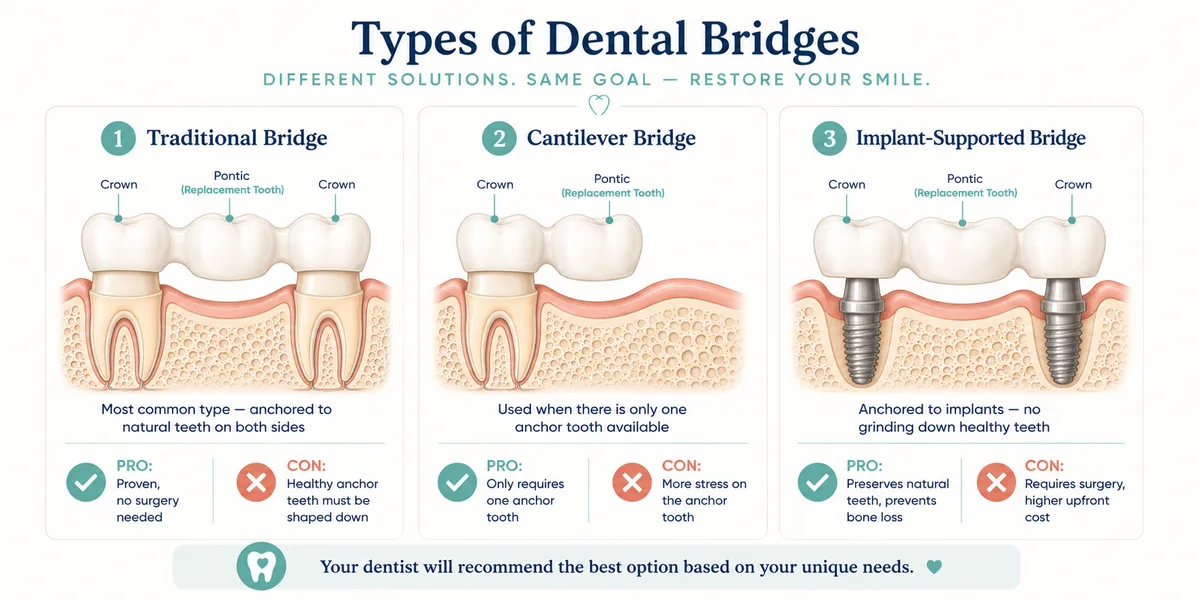
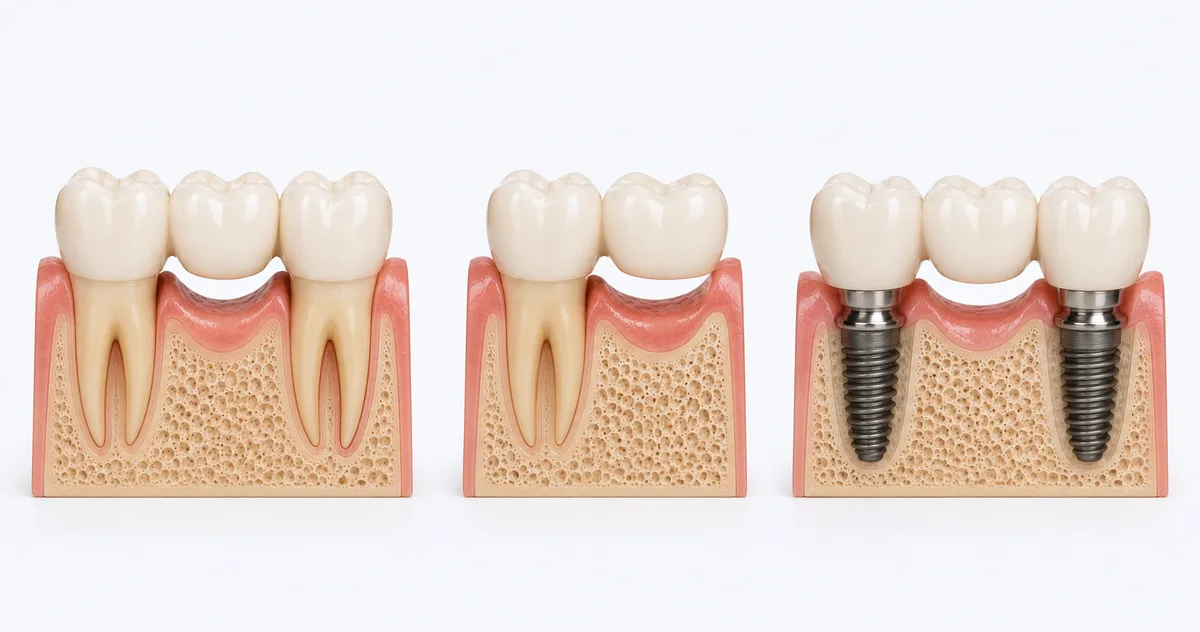
Left: traditional bridge. Center: cantilever bridge. Right: implant-supported bridge.
Traditional Bridge
The most common type. Crowns are placed on the healthy teeth on both sides of the gap, with a false tooth suspended between them. Reliable, proven, and does not require surgery.
Consideration: The anchor teeth need to be shaped down to fit the crowns — even if they are healthy.
Best for: Patients with strong natural teeth on both sides of the gap
Cantilever Bridge
Used when there is only one natural tooth next to the gap instead of two. The bridge is anchored to that single tooth.
Consideration: More stress is placed on the one anchor tooth, so this option is used selectively.
Best for: Specific situations where only one anchor tooth is available
Implant-Supported Bridge
Instead of anchoring to natural teeth, the bridge is supported by dental implants placed in the jawbone. No healthy teeth need to be shaped down.
Consideration: Requires a surgical procedure to place the implants. Higher upfront cost but preserves the natural teeth and prevents bone loss.
Best for: Patients who want to avoid altering healthy teeth, or who are missing multiple teeth in a row
What Happens If You Leave the Gap?
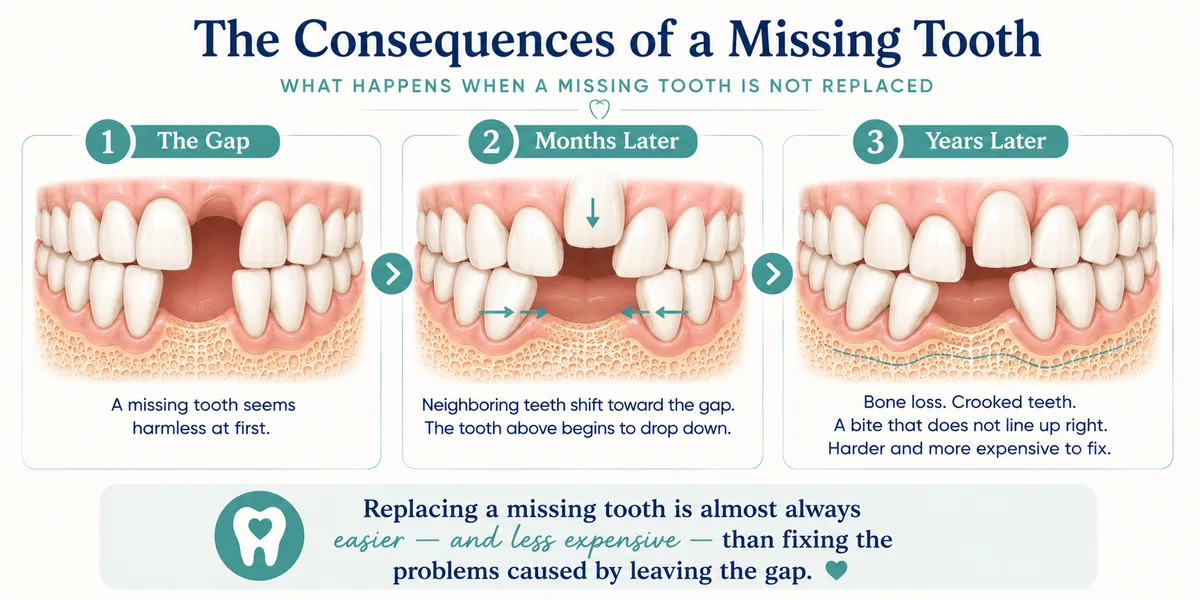
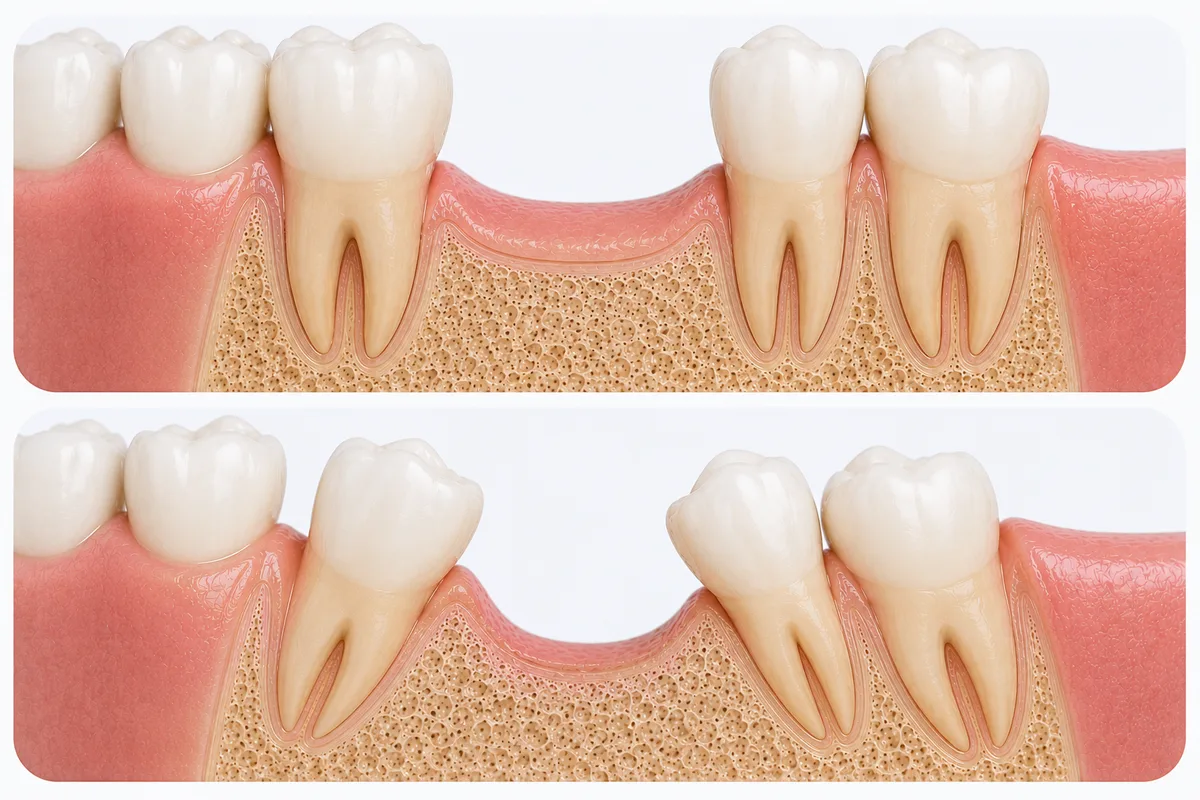
Top: fresh gap, teeth still straight. Bottom: months later — teeth shift, bone begins to shrink.
A lot of people figure they will deal with a missing tooth later. And we get that — dental work costs money and nobody is in a hurry to spend it.
But here is the problem. Once a tooth is gone, the neighboring teeth start to drift toward the empty space. The tooth on the opposite arch — the one that used to bite against the missing tooth — starts to super-erupt. That means it slowly grows out of the socket because it has nothing to bite against anymore.
Over time the bone in that area starts to shrink because there is no tooth root to stimulate it. Your bite changes. Other teeth get crooked. What started as a simple gap becomes a much bigger — and more expensive — problem to fix.
A bridge stops all of that. It fills the gap, keeps the surrounding teeth in place, and gives the opposing tooth something to bite against. The sooner you replace a missing tooth, the simpler and less expensive the fix is.
“Very nice staff! They cared and explained in detail the process!”
“Very nice staff! They cared and explained in detail the process! Highly recommended.”— James M.
How Do You Choose?
Bridge
- ✓ No surgery required
- ✓ Faster — usually 2–3 appointments
- ✓ Lower upfront cost
- ✓ Good long-term option with proper care
- ⚠ Anchor teeth must be shaped down
- ⚠ Does not prevent bone loss under the pontic
Best for: Patients who want to avoid surgery or need a faster solution
Implant
- ✓ No alteration to neighboring teeth
- ✓ Prevents bone loss in the jaw
- ✓ Closest thing to a natural tooth
- ✓ Can last a lifetime with proper care
- ⚠ Requires surgery and healing time
- ⚠ Higher upfront cost
Best for: Patients who want the most permanent, conservative long-term solution
Partial Denture
- ✓ Removable — clips onto remaining teeth
- ✓ No surgery required
- ✓ Lower upfront cost than fixed options
- ⚠ Less stable than a bridge or implant
- ⚠ Must be removed for cleaning
- ⚠ May need adjustments or replacement over time
Best for: Patients missing multiple teeth who want a non-surgical, lower-cost option
Not sure which is right for you? We will walk you through all three options at your appointment — no pressure, just honest answers.
Getting a Bridge at Rabbit Creek Dental
-
1
Exam & Treatment Planning
We examine the gap, the anchor teeth, and the surrounding bone. We take X-rays and discuss your options. If a bridge is the right fit, we explain exactly what to expect.
-
2
Preparing the Anchor Teeth
We numb the area and shape the anchor teeth on either side of the gap so the crowns will fit properly over them. We take a digital scan — no messy putty impressions.
-
3
Temporary Bridge
While your custom bridge is being made, we place a temporary bridge to protect the prepared teeth and fill the gap. You wear this for about 2 to 3 weeks.
-
4
Placing the Permanent Bridge
When your bridge is ready, we check the fit, bite, and appearance before cementing it permanently in place. We make any adjustments right there so everything feels natural.
Most bridge procedures require two appointments plus a follow-up. The whole process usually takes 3 to 4 weeks from start to finish.
Frequently Asked Questions About Dental Bridges
Most bridges last 10 to 15 years or longer with good care. How long yours lasts depends on where it is, how well you clean under it, and the health of the anchor teeth.
It depends on your situation — the health of your neighboring teeth, how much bone you have, your timeline, and your budget. We will go over both options with you honestly and help you decide what makes the most sense for your mouth and your life.
Yes. We use porcelain or zirconia that's matched to the color of your surrounding teeth. The artificial tooth in the middle (called a pontic) is shaped to look like a natural tooth and sit naturally against the gum. Most people won't be able to tell the difference.
It depends on your situation. If the teeth anchoring the bridge are already present and healthy, the process is similar to a crown — two appointments about 2-3 weeks apart. We prepare the anchor teeth, take a digital scan, place a temporary bridge, and cement the permanent bridge when it comes back from the lab. If we're extracting a tooth and placing a bridge in the same area, the timeline is longer — the extraction site needs to heal before we take the final impression, which can mean 10-12 weeks in a temporary. We'll give you a clear timeline at your consultation.
We numb everything completely before we start. The preparation appointment involves some pressure but should not be painful. Some soreness for a day or two afterward is normal.
Yes — once the permanent bridge is cemented, you can eat normally. We recommend avoiding extremely hard or sticky foods that could put unusual stress on it, and our guide to caring for your new bridge covers the daily habits that keep it in good shape.
You cannot floss between the teeth the normal way since the bridge is one connected piece. We will show you how to use a floss threader or a water flosser to clean under the pontic. Keeping that area clean is important for the health of the anchor teeth.
The teeth on either side of the gap (called abutment teeth) need to be prepared — we reduce them in size so the crowns that anchor the bridge can fit over them. This is permanent. Those teeth will always need to be covered by a crown going forward. If the neighboring teeth are already heavily restored or need crowns for other reasons, this is less of a concern. If they're perfectly healthy, it's worth having a conversation about whether an implant might be a better long-term option.
It can, though it's not common. The same causes as a crown — cement washing out, decay developing under one of the anchor crowns, or trauma. If your bridge feels loose or comes off, call us right away. Don't try to recement it yourself.
Most dental insurance plans cover bridges at least partially. We will verify your benefits before your appointment so you have a clear estimate of your costs.
Absolutely. The crowns anchoring the bridge can't get cavities, but the teeth underneath them can — decay can develop at the margins if plaque builds up consistently. Bridges require extra attention because you need to clean under the pontic (the artificial tooth in the middle) where a regular toothbrush can't reach. We'll show you how to use a floss threader or water flosser to keep the area clean. Patients who don't change the habits that caused the original problem often end up with new decay under or around the restoration within a few years.
Missing a Tooth?
The sooner you fill the gap the simpler the fix. Come in and let us take a look at what is going on.