
- Don't eat or drink for 60 minutes after your permanent crown is cemented
- Some sensitivity to hot and cold is normal for the first week to ten days
- Flossing around your crown every day is the single best thing you can do for it
- Call us if your bite feels off or sensitivity gets worse instead of better
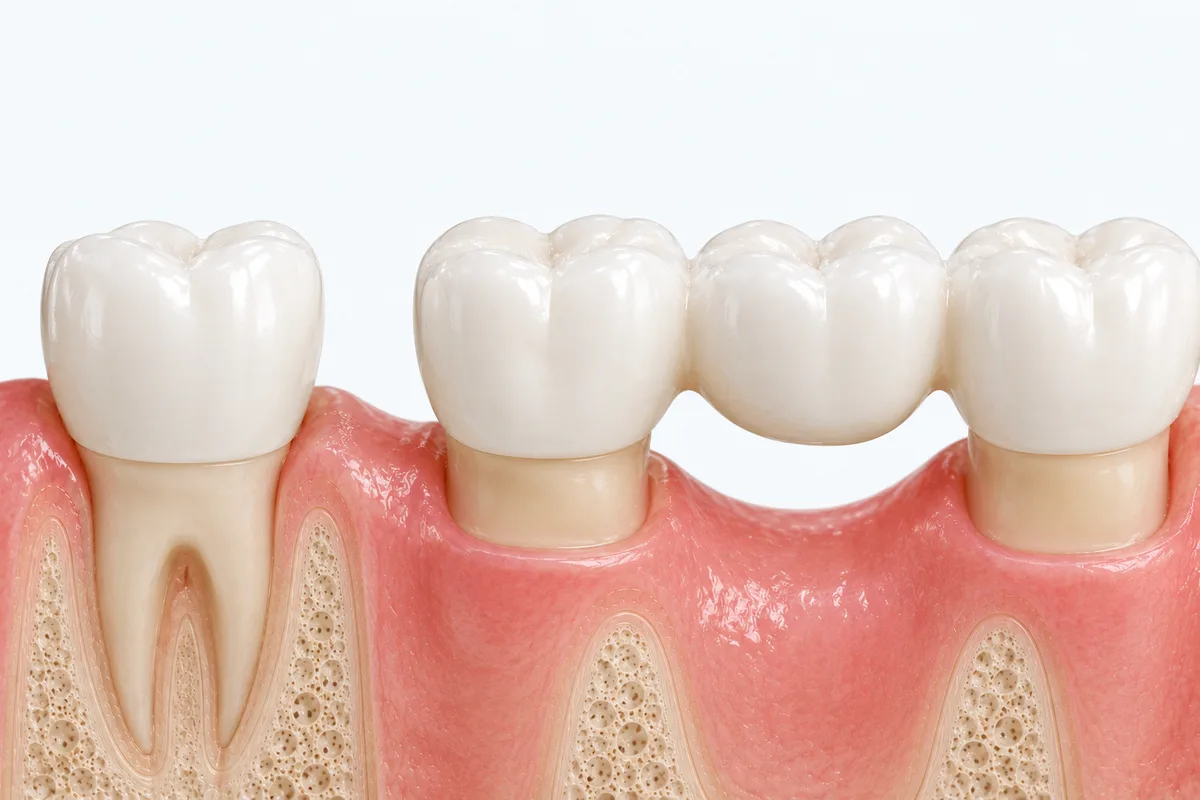
A crown is a cap that fits over a damaged tooth, kind of like a ring around a barrel, to keep it from cracking or breaking. A bridge is two or more crowns joined together to fill the space left by a missing tooth.
Getting a crown usually takes two visits. Here's what to expect at each one and how to care for things along the way.
First Visit: Preparing the Tooth
At your first appointment, we shape the tooth and take a mold so our dental lab can build your final crown. While that's being made, you'll wear a temporary crown. That temporary is held on with a soft cement that washes out over time, so a little sensitivity to hot and cold is normal. A few tips while you have the temporary:
- Brush the area gently.
- When you floss, slide the floss out from the side instead of pulling straight up. Pulling up can tug the temporary loose.
- If your temporary comes loose or falls off, clean the cement out of the inside, then dab a little toothpaste, denture adhesive, or temporary crown cement inside and slip it back on the tooth.
- Give us a call so we can re-cement it or make a new one if needed.
Second Visit: Your Permanent Crown
Once your final crown is cemented, here's what to keep in mind:
- Don't eat or drink for 60 minutes after it's cemented. Skip hard or sticky foods for 24 hours while the cement fully sets.
- Your new crown might feel tight or like it's pushing against the tooth next to it for a few hours. That usually eases up within a day or two.
- Sensitivity to hot and cold is common at first. It's a reaction between the cement and the tooth, and it usually settles down within a week to ten days. The deeper the original cavity, the more sensitive the tooth tends to be.
- The new crown may feel a little different in shape or texture than your old tooth. Your tongue tends to magnify that, but you'll get used to it in a few days.
A well-made crown or bridge should end up feeling just as comfortable as your own tooth.
Keeping It Healthy
Treat your crown like the investment it is:
- Brush twice a day at a 45-degree angle along the gumline.
- Floss once a day. This is especially important around a crown or bridge to keep cavities and gum disease away.
- If your bite feels off, or if sensitivity hangs around or gets worse, make an adjustment appointment. Lingering or out-of-nowhere pain can sometimes be a sign the tooth needs a root canal.
Frequently Asked Questions
Don't panic. Clean it out, set it back on with a little toothpaste or denture adhesive to hold it, and call us so we can re-cement it properly.
Some hot-and-cold sensitivity is normal after cementing, especially if the cavity was deep. It usually calms down within a week to ten days.
That tight or "pushing" feeling is common for the first few hours and usually fades within a day or two. If it sticks around, give us a call.
With good brushing, flossing, and regular checkups, a crown can last for many years. Flossing around it is one of the best things you can do.

Dr. Joseph Gegzna, DMD is the founder and lead dentist at Rabbit Creek Dental in Mobile, Alabama. He earned his Doctor of Dental Medicine degree from the University of Louisville School of Dentistry and has been a licensed dentist in Alabama since 2014, with more than 12 years of experience in general, restorative, and implant dentistry. After several years practicing as an associate, he founded Rabbit Creek Dental in 2022 to build the kind of patient-first practice he believed in. He has completed advanced implant training through a 92-hour Implant Pathway program with live patient surgery and additional surgical training in impacted third molar extractions through the Koerner Center for Surgical Instruction. He is a member of the American Dental Association and is currently in his third year of the Bulletproof Dental Mastermind program, a continuing education group focused on delivering an exceptional patient experience. Before dentistry, Dr. Gegzna was a licensed pilot, bringing a calm, detail-oriented approach to patient care. Rabbit Creek Dental serves families throughout Mobile.
This article is for educational purposes only and does not constitute medical advice. For personalized guidance about your dental health, please contact our office at (251) 308-0584.