
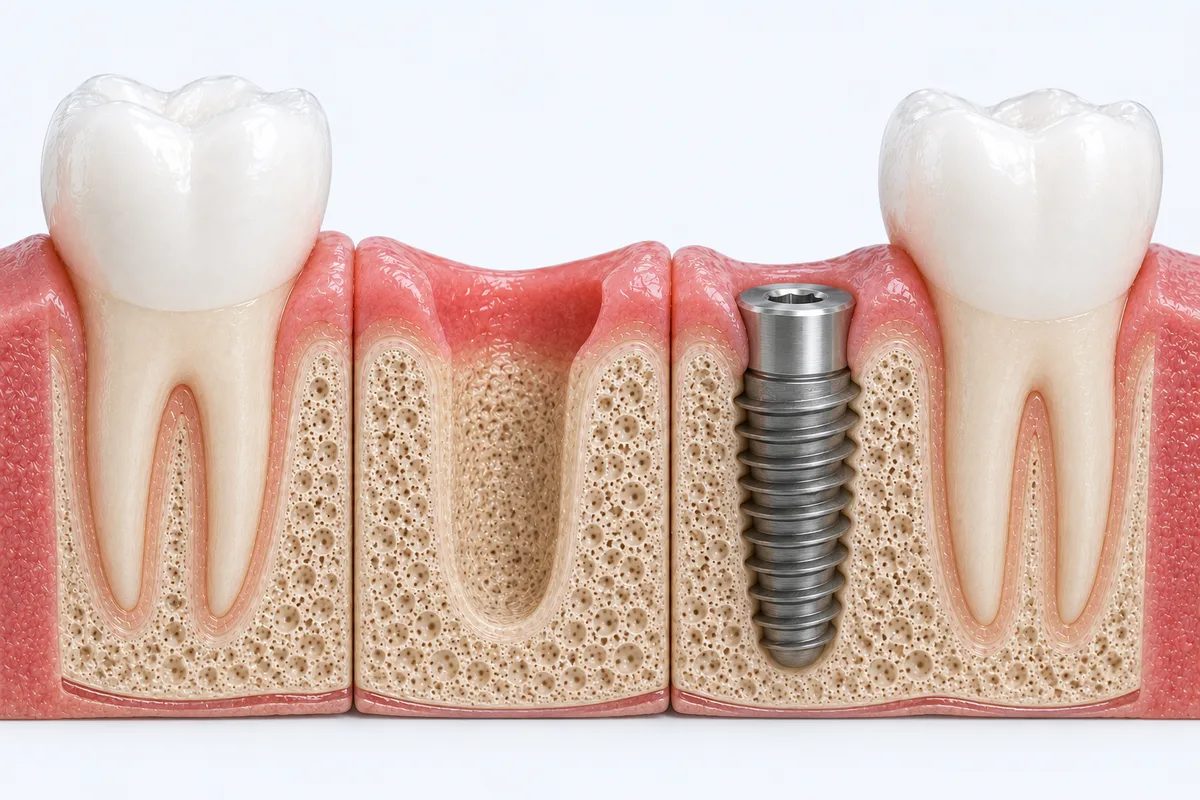
- Implants are a titanium post that fuses to your jawbone — they can last decades
- Smoking is the #1 cause of implant failure — plan to quit during healing
- Some medications (SSRIs, PPIs) can interfere with healing — talk to your doctor before placement
- The full process takes several months, but most patients say it's worth every bit of it
Thinking about a dental implant? It's one of the best ways to replace a missing tooth, and a little preparation goes a long way toward a smooth, successful result. Here's what to know before your implant.
What a Dental Implant Is
A dental implant is a small titanium post that takes the place of the root of a missing tooth. We place it into your jawbone, where it fuses with the bone and becomes a strong, sturdy foundation for a crown, bridge, or denture. Implants look and feel like natural teeth. They make it easier to chew and speak, they're great for your confidence, and with good care they often last for decades.
Are You a Good Candidate?
You may be a good fit for a dental implant if you:
- Are missing one or more teeth
- Have a loose-fitting denture
- Have healthy gums
- Have enough bone to support the implant (or can have a bone graft)
- Don't smoke, or are willing to stop while you heal
- Don't have uncontrolled health conditions like diabetes or autoimmune disorders
Not sure if you qualify? That's exactly what a consultation is for. We'll take a look and give you a straight answer.
What the Process Looks Like
Getting an implant happens in steps:
- Consult and imaging. We do a dental exam, a 3D CT scan, and a digital scan of your mouth, then plan your treatment.
- Tooth removal (if needed). If a tooth needs to come out, we may place a bone graft to preserve the bone. Grafts often need 4–6 months to heal before they're ready for an implant.
- Implant placement. We place the titanium implant in your jawbone under local anesthesia. Healing takes about 4–6 months, depending on your bone.
- Abutment and crown. Once the implant has fused, we attach a connector piece and make your crown, bridge, or denture to fit.
Learn more about what the full process involves on our dental implants page.
Setting Yourself Up for Success
A few things can really help your implant heal well:
- Supplements. Starting 2–4 weeks before your implant, we may suggest vitamin D3 (1,000–5,000 IU daily) and collagen or vitamin C to support healing. Vitamin K2 (90–180 mcg daily) is an optional add-on.
- Prescriptions. We'll usually prescribe antibiotics, a steroid, and a prescription mouthwash to help manage the surgical site and support healing.
- No smoking. Smoking is a major cause of implant failure. Avoid smoking or vaping for at least 2–4 weeks, and ideally through the whole healing period.
A Note About Certain Medications
Some everyday medicines can interfere with how well an implant fuses to the bone. These include certain antidepressants (the SSRI and tricyclic families, like Celexa, Prozac, Paxil, Zoloft, amitriptyline, and others) and certain heartburn or acid reflux medicines called proton pump inhibitors (like Prilosec, Nexium, Prevacid, and Protonix). If you take one of these, talk with your physician about whether to pause or switch it — usually starting 2–4 weeks before placement and continuing 4–6 months into healing. Never stop a prescription on your own. Always work with your doctor first.
Frequently Asked Questions
It varies, but plan on several months. The bone needs about 4–6 months to fuse with the implant, and a bone graft (if needed) adds healing time before that.
We place implants under local anesthesia, so you're comfortable during the procedure. Most patients are surprised by how manageable the recovery is.
Smoking is one of the leading reasons implants fail. Quitting — even just during healing — dramatically improves your odds of success.
With good care, implants often last for decades. They're one of the most durable ways to replace a tooth.
Next Steps in Your Implant Journey:
Dr. Joseph Gegzna, DMD is the founder and lead dentist at Rabbit Creek Dental in Mobile, Alabama. He earned his Doctor of Dental Medicine degree from the University of Louisville School of Dentistry and has been a licensed dentist in Alabama since 2014, with more than 12 years of experience in general, restorative, and implant dentistry. After several years practicing as an associate, he founded Rabbit Creek Dental in 2022 to build the kind of patient-first practice he believed in. He has completed advanced implant training through a 92-hour Implant Pathway program with live patient surgery and additional surgical training in impacted third molar extractions through the Koerner Center for Surgical Instruction. He is a member of the American Dental Association and is currently in his third year of the Bulletproof Dental Mastermind program, a continuing education group focused on delivering an exceptional patient experience. Before dentistry, Dr. Gegzna was a licensed pilot, bringing a calm, detail-oriented approach to patient care. Rabbit Creek Dental serves families throughout Mobile.
This article is for educational purposes only and does not constitute medical advice. For personalized guidance about your dental health, please contact our office at (251) 308-0584.