
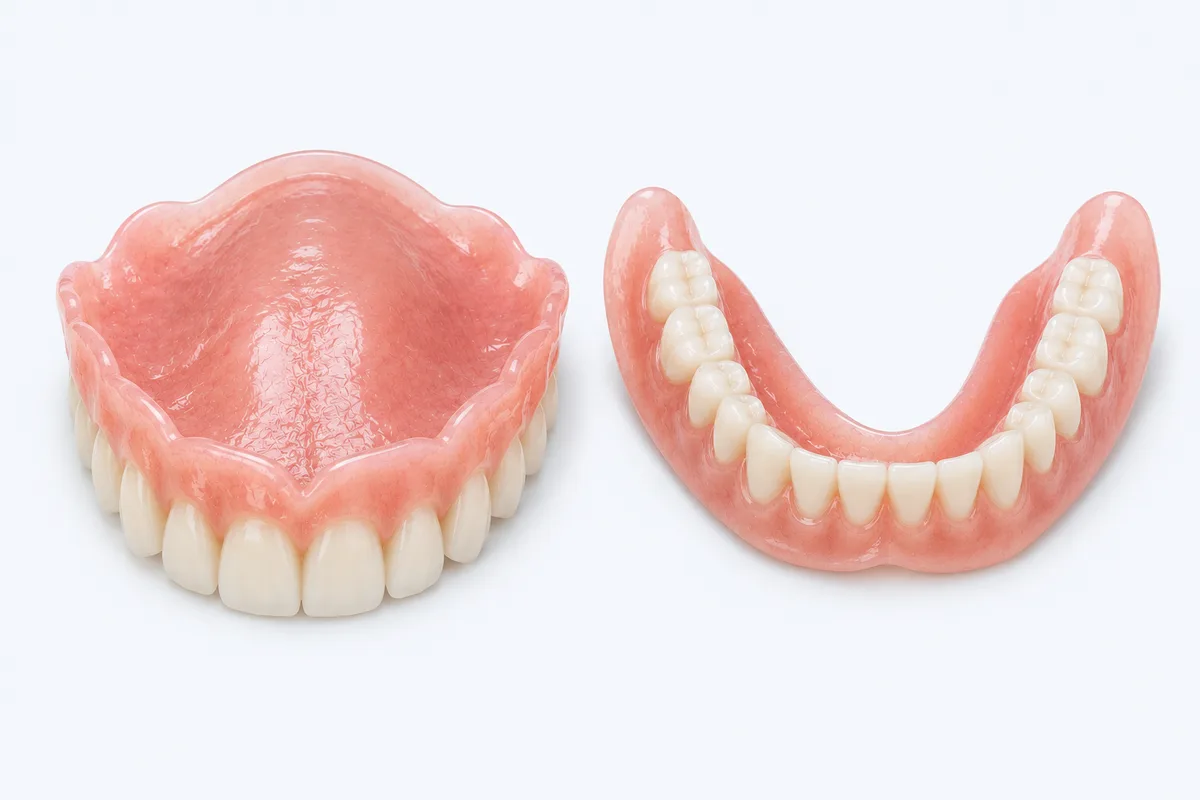
- A complete denture restores roughly 10% of the function of natural teeth — we'll always recommend fixed options first
- Traditional dentures fit better; immediate dentures mean you're never without front teeth
- Lower dentures almost always need adhesive — implants are the modern standard for lower arch retention
- Patience is the biggest factor — think of it like breaking in a new pair of shoes
If you're facing the loss of several teeth, dentures can give you back a smile and the ability to eat and talk. But there's a lot to understand before you start, and we believe in being honest with you up front. Here's the real picture.
First, Let's Talk Options
Whenever we can, we recommend fixed replacements like bridges, implants, and crowns, because patients are almost always happier with those than with removable options like dentures. And when a denture is the right choice, we'll try to keep you in a partial denture instead of a complete one whenever possible — again, because patients tend to be happier with partials than with full dentures.
An Honest Word About What Dentures Can Do
Here's something important: a denture isn't really a replacement for teeth. It's a replacement for the empty space where teeth used to be. Think of it this way — if having all your natural teeth is 100% function, and having no teeth is 0%, a complete denture gets the average patient up to about 10% function. We can design a denture that gives you a great smile, a proper bite, and good comfort. What we can't do is make you love a denture. They often feel bulky and strange when they're new, and they take patience and practice while your muscles learn to eat and talk with them. It's a lot like breaking in a new pair of shoes — uncomfortable at first, then they start to feel like part of you. The more you wear them, the faster you'll adjust.
A Note About Adhesive
If you're getting complete upper or lower dentures, plan on using denture adhesive. We always aim for the best possible fit, and many patients don't need much (especially with upper dentures). But lower dentures are famous for poor grip, and they usually need adhesive. In fact, the modern standard of care is to place implants to help hold lower dentures in place.
Two Main Types: Traditional and Immediate
Traditional dentures are the best and most predictable way to get a well-fitting denture. We do all the other recommended work first — fillings, crowns, root canals, extractions. Then, after any extractions, we let the area heal for at least 2–8 weeks before taking impressions to make your denture.
Immediate dentures are a good option when we're replacing your front teeth and you'd rather not go without teeth while you heal.
- If only your front teeth are involved, we can sometimes take an impression at the first visit and deliver the denture (after extractions) at the second.
- If both front and back teeth are involved, we usually remove the back teeth first and complete any other needed work. After those areas heal, we take an impression, then remove the front teeth the same day we deliver your denture — so you're never seen without front teeth.
One thing to expect with immediate dentures: as your gums heal, they shrink, but your denture stays the same size, so it can get loose. If that happens, a denture reline (for an additional charge) snugs it back up against your tissue for better fit and grip.
Frequently Asked Questions
Not at first — and that's normal. New dentures feel bulky and strange for a while. With practice, they start to feel like a natural part of your mouth.
Because patients are almost always happier with them. When a denture is the right call, we'll guide you to the best version for your situation.
Traditional dentures are made after your gums heal, so they fit more predictably. Immediate dentures let you avoid going without front teeth, but they often need a reline later as your gums change.
Many upper dentures do fine without much. Lower dentures usually need some help. We'll find what works for you.
Dr. Joseph Gegzna, DMD is the founder and lead dentist at Rabbit Creek Dental in Mobile, Alabama. He earned his Doctor of Dental Medicine degree from the University of Louisville School of Dentistry and has been a licensed dentist in Alabama since 2014, with more than 12 years of experience in general, restorative, and implant dentistry. After several years practicing as an associate, he founded Rabbit Creek Dental in 2022 to build the kind of patient-first practice he believed in. He has completed advanced implant training through a 92-hour Implant Pathway program with live patient surgery and additional surgical training in impacted third molar extractions through the Koerner Center for Surgical Instruction. He is a member of the American Dental Association and is currently in his third year of the Bulletproof Dental Mastermind program, a continuing education group focused on delivering an exceptional patient experience. Before dentistry, Dr. Gegzna was a licensed pilot, bringing a calm, detail-oriented approach to patient care. Rabbit Creek Dental serves families throughout Mobile.
This article is for educational purposes only and does not constitute medical advice. For personalized guidance about your dental health, please contact our office at (251) 308-0584.