
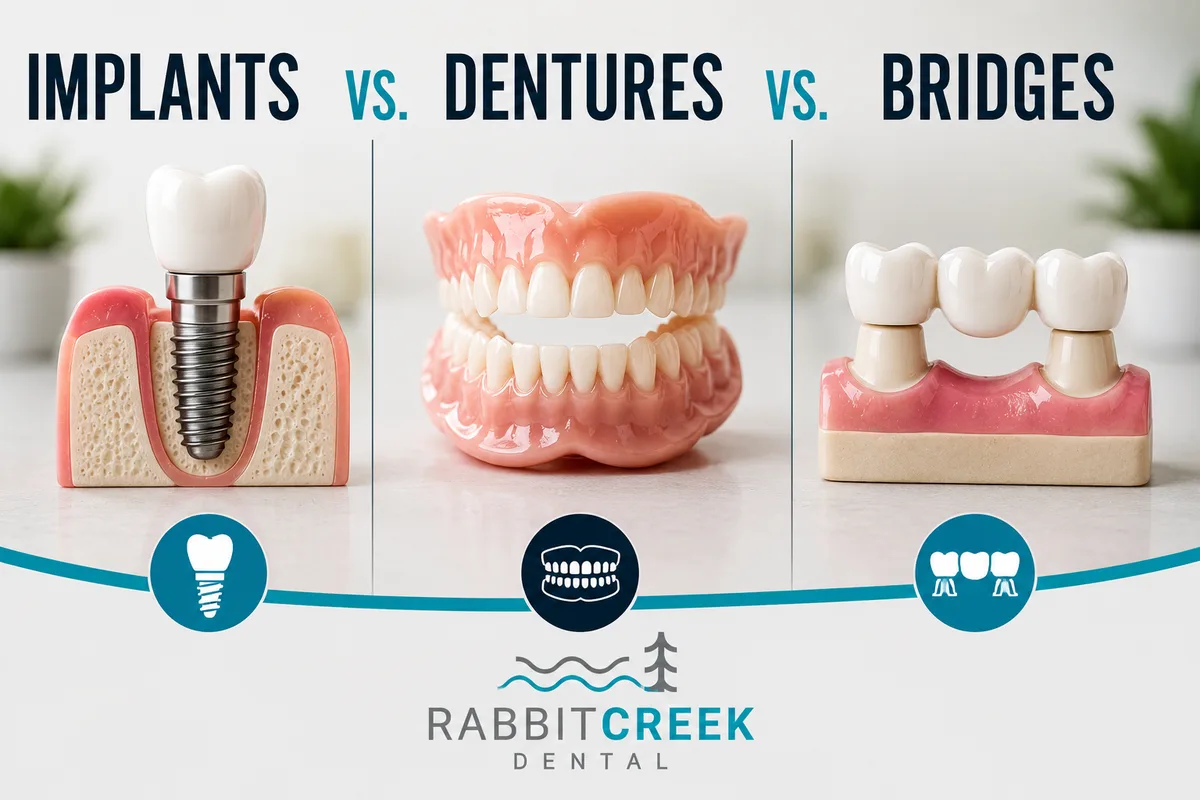
- All three replace missing teeth but work and last differently
- Implants are most permanent and preserve jawbone
- Bridges are fixed and need no surgery; dentures are most affordable but removable
- The right choice depends on how many teeth are missing, bone health, budget, and goals
If you're missing one or more teeth, you have real options. The challenge is that each option works differently, costs differently, and has different long-term implications. This guide breaks down all three so you can walk into your consultation with a clear picture.
The Short Version
| Implant | Bridge | Denture | |
|---|---|---|---|
| Fixed or removable | Fixed | Fixed | Removable |
| Preserves jawbone | Yes | No | No |
| Affects neighboring teeth | No | Yes | No |
| Surgery required | Yes | No | No |
| Lifespan | Decades | 10–15 years | 5–10 years |
| Best for | 1–2 missing teeth | 1–3 missing teeth | Multiple/all missing teeth |
| Relative cost | Highest | Moderate | Lowest |
Dental Implants
A dental implant replaces the entire tooth — root and all. A titanium post is surgically placed in the jawbone, allowed to fuse with the bone over several months, and then topped with a custom crown.
What makes implants the gold standard: the only option that stimulates and preserves jawbone; doesn't require modifying or touching neighboring teeth; functions and feels most like a natural tooth; can last decades with proper care.
The tradeoffs: highest upfront cost; requires surgery and a healing period of several months; not everyone qualifies — bone volume and overall health matter.
Cost: Based on FAIR Health Consumer data for Mobile, AL (as of June 2026), a complete single implant typically ranges from $4,600 to $5,500 before insurance. With PPO insurance, costs may be lower. RCD Dental Savings Plan members save 20%.
Am I a candidate for implants? → and How long does the implant process take? →
Dental Bridges
A fixed bridge uses the two teeth on either side of the gap as anchors. Those teeth are filed down and fitted with crowns, and an artificial tooth (called a pontic) is suspended between them. The bridge is cemented permanently in place.
What makes bridges a strong option: fixed — doesn't come out; no surgery required; faster than an implant — typically 2–3 appointments; lower upfront cost than an implant.
The tradeoffs: requires permanently altering two healthy neighboring teeth; doesn't preserve jawbone — bone loss continues in the gap area; typically needs replacement after 10–15 years.
Cost: Bridge costs vary based on the teeth involved. Contact our office for a personalized estimate.
Dentures
Dentures are removable appliances that replace multiple missing teeth — or all of them. A full denture replaces an entire arch. A partial denture fills in gaps when some natural teeth remain.
What makes dentures a reasonable option: lowest upfront cost of the three; no surgery required; can replace many teeth at once.
The tradeoffs: removable — taken out for cleaning and sleeping; can feel loose or shift while eating or speaking; don't preserve jawbone; require periodic relines as the bone changes shape; may need replacement every 5–10 years.
Cost: According to FAIR Health Consumer data for Mobile, AL (as of June 2026): full denture $1,400–$2,400; partial denture $1,679–$2,153 (mandibular) / $1,500–$2,100 (maxillary). With PPO insurance costs may be lower. RCD Dental Savings Plan members save 20%.
Implant-Supported Dentures
Worth mentioning: implant-supported dentures combine both worlds. Dental implants anchor a denture in place, giving you the stability of a fixed appliance at a lower cost than replacing every tooth with an individual implant. For patients missing most or all of their teeth, this is often the best value.
Which Option Is Right for You?
Choose implants if: you're missing one or a few teeth, have adequate bone, and want the most natural, long-lasting result.
Choose a bridge if: you want a fixed solution without surgery, especially if the neighboring teeth already need crowns.
Choose dentures if: you're missing most or all of your teeth, or budget is the primary concern right now.
Consider implant-supported dentures if: you're missing most or all of your teeth and want more stability than traditional dentures provide.
Don't wait to address missing teeth. The longer a tooth is gone, the more bone loss occurs — and that limits your options later.
No insurance? Here's how to save → and Learn about dental financing →
We serve patients from Mobile, Theodore, Grand Bay, and the surrounding Gulf Coast area.
Cost ranges based on FAIR Health Consumer data for Mobile, AL (zip 36695) as of June 2026. Actual fees vary by provider, case complexity, and insurance.
Frequently Asked Questions
For most patients missing one or a few teeth, yes — implants preserve bone, function more naturally, and last longer. For patients missing most or all teeth, implant-supported dentures often offer the best combination of stability and value.
Most bridges last 10–15 years with proper care. They eventually need replacement, and the teeth underneath can develop decay if oral hygiene slips.
Yes — many denture patients later choose to add implants to anchor their denture more securely. This is called an implant-supported or implant-retained denture.
Coverage varies by plan. Most PPO plans cover a portion of bridges and dentures. Implant coverage varies widely. We'll verify your specific benefits at your consultation.
Dr. Joseph Gegzna, DMD is the founder and lead dentist at Rabbit Creek Dental in Mobile, Alabama. He earned his Doctor of Dental Medicine degree from the University of Louisville School of Dentistry and has been a licensed dentist in Alabama since 2014, with more than 12 years of experience in general, restorative, and implant dentistry. After several years practicing as an associate, he founded Rabbit Creek Dental in 2022 to build the kind of patient-first practice he believed in. He has completed advanced implant training through a 92-hour Implant Pathway program with live patient surgery and additional surgical training in impacted third molar extractions through the Koerner Center for Surgical Instruction. He is a member of the American Dental Association and is currently in his third year of the Bulletproof Dental Mastermind program, a continuing education group focused on delivering an exceptional patient experience. Before dentistry, Dr. Gegzna was a licensed pilot, bringing a calm, detail-oriented approach to patient care. Rabbit Creek Dental serves families throughout Mobile.
This article is for educational purposes only and does not constitute medical advice. Cost ranges are based on FAIR Health Consumer data for the Mobile, AL area as of June 2026 and are subject to change. For personalized guidance and exact pricing, please contact our office at (251) 308-0584.