
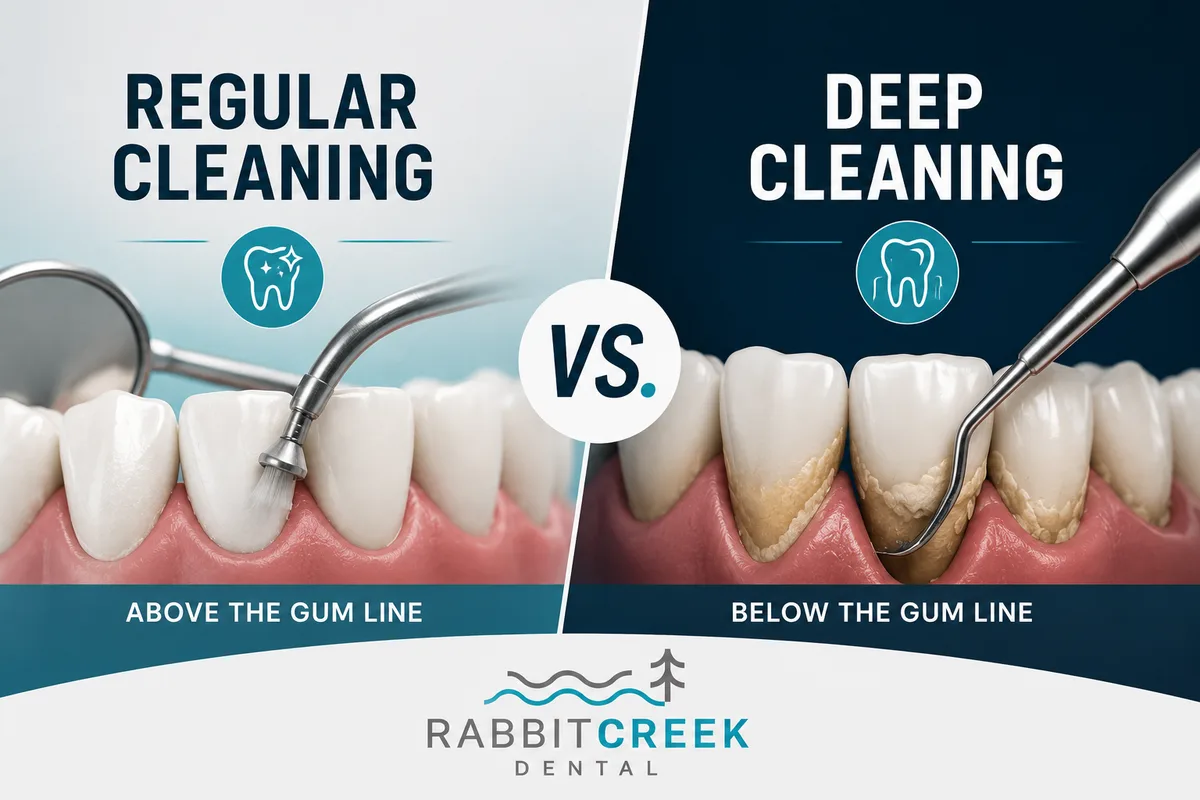
- A regular cleaning maintains healthy gums; a deep cleaning treats gum disease by removing bacteria and buildup below the gumline
- They're different procedures with different purposes and costs
- Per FAIR Health Consumer data for Mobile, AL (June 2026), a deep cleaning typically costs $285–$315 per quadrant
- Most PPO plans cover a portion when medically necessary
If your hygienist has recommended a deep cleaning, your first reaction might be: why does this cost more than my regular cleaning? Isn't it just... a more thorough cleaning? Not exactly. Here's the difference — and why it matters.
Regular Cleaning vs. Deep Cleaning: What's Actually Different?
A regular cleaning (prophylaxis) is a preventive maintenance procedure. It removes plaque and tartar from the surfaces of your teeth above the gumline and polishes the enamel. It's designed for patients with healthy gums as a way to keep them that way.
A deep cleaning (scaling and root planing) is a treatment for gum disease. It goes below the gumline to remove bacteria, tartar, and buildup from the root surfaces of your teeth — areas that a regular cleaning doesn't reach and that your toothbrush definitely can't reach.
The difference isn't just how thorough it is. It's what the procedure is treating and where the work happens.
Why Is a Deep Cleaning Necessary?
When plaque builds up along and below the gumline and isn't removed, bacteria cause the gum tissue to pull away from the teeth, creating pockets. Bacteria colonize those pockets, cause infection, and begin destroying the bone and tissue that hold your teeth in place. That's gum disease — specifically periodontitis. A regular cleaning can maintain healthy gums. It cannot treat active gum disease. Once pockets deepen and infection sets in below the gumline, a deep cleaning is the appropriate treatment. Your hygienist measures the depth of your gum pockets at every checkup. Healthy pockets are 1–3mm. Pockets of 4mm or more with signs of bleeding and bone loss indicate gum disease and typically require scaling and root planing.
What Happens During a Deep Cleaning?
Scaling and root planing is usually done in two appointments — one side of the mouth at a time. Local anesthetic is used so you're comfortable throughout. Scaling removes the hardened tartar (calculus) and bacteria from below the gumline and from the surfaces of the roots. Root planing smooths the root surfaces so that gum tissue can reattach to the tooth. Rough root surfaces give bacteria more places to hide and make it harder for gums to heal. After a deep cleaning, most patients need more frequent maintenance cleanings — every 3–4 months instead of every 6 — to keep gum disease from progressing further.
What Does a Deep Cleaning Cost?
According to FAIR Health Consumer data for Mobile, AL (as of June 2026), scaling and root planing typically costs: $285–$315 per quadrant (D4341 — involving 4 or more teeth per quadrant); $200–$300 per quadrant (D4342 — involving 1–3 teeth per quadrant). Most mouths are divided into 4 quadrants. If all four need treatment, the total cost will reflect that. Most PPO dental plans cover scaling and root planing as a medically necessary procedure, typically at 50–80% after your deductible. We'll verify your benefits before treatment so you know what to expect. RCD Dental Savings Plan members receive 20% off treatment fees.
Does Delta Dental cover deep cleanings? → and No insurance? Here's how to save →
Not sure whether you need a deep cleaning? Come in and we'll measure and tell you straight.
Call (251) 308-0584 Book OnlineShould I Get a Deep Cleaning If My Insurance Won't Cover It Fully?
Yes — if your hygienist recommends it, it means gum disease is present and needs treatment. Gum disease doesn't resolve on its own. It progresses slowly, often without pain, until it's caused significant damage — bone loss, loose teeth, and eventually tooth loss. A deep cleaning at the right time is almost always less expensive than treating the damage caused by untreated gum disease.
What happens if you don't treat gum disease? →
We serve patients from Mobile, Theodore, Grand Bay, and the surrounding Gulf Coast area.
Cost ranges based on FAIR Health Consumer data for Mobile, AL (zip 36695) as of June 2026.
Frequently Asked Questions
No. A regular cleaning maintains healthy gums above the gumline. A deep cleaning treats gum disease by removing buildup from below the gumline and smoothing root surfaces. They're different procedures for different clinical situations.
Your hygienist measures your gum pocket depths at every checkup. Pockets of 4mm or more with bleeding and bone loss indicate gum disease that typically requires scaling and root planing.
Local anesthetic is used so the procedure is comfortable. Your gums may be tender for a day or two afterward, which is normal.
Once gum disease has been treated with a deep cleaning, most patients need maintenance cleanings every 3–4 months to keep it under control. This is different from the every-6-months schedule for healthy patients.

Dr. Joseph Gegzna, DMD is the founder and lead dentist at Rabbit Creek Dental in Mobile, Alabama. He earned his Doctor of Dental Medicine degree from the University of Louisville School of Dentistry and has been a licensed dentist in Alabama since 2014, with more than 12 years of experience in general, restorative, and implant dentistry. After several years practicing as an associate, he founded Rabbit Creek Dental in 2022 to build the kind of patient-first practice he believed in. He has completed advanced implant training through a 92-hour Implant Pathway program with live patient surgery and additional surgical training in impacted third molar extractions through the Koerner Center for Surgical Instruction. He is a member of the American Dental Association and is currently in his third year of the Bulletproof Dental Mastermind program, a continuing education group focused on delivering an exceptional patient experience. Before dentistry, Dr. Gegzna was a licensed pilot, bringing a calm, detail-oriented approach to patient care. Rabbit Creek Dental serves families throughout Mobile.
This article is for educational purposes only and does not constitute medical advice. Cost ranges are based on FAIR Health Consumer data for the Mobile, AL area as of June 2026 and are subject to change. For personalized guidance and exact pricing, please contact our office at (251) 308-0584.