
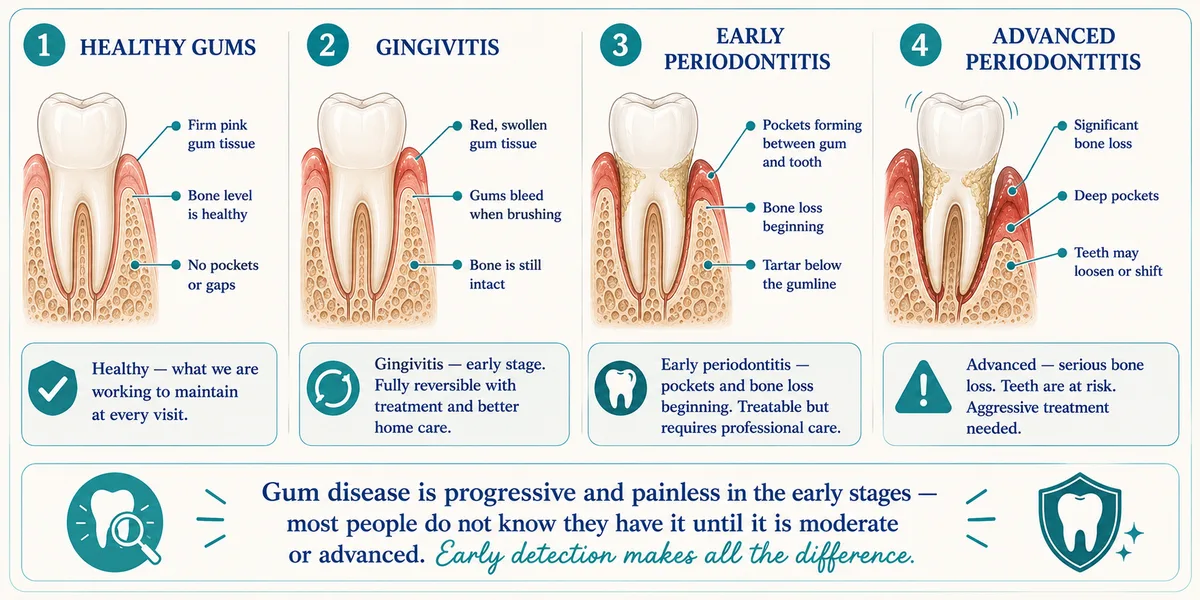
- Untreated gum disease progresses from inflammation (gingivitis) to infection (periodontitis) to bone loss and tooth loss
- It's linked to serious health conditions including heart disease and diabetes complications
- Early gum disease is very treatable — advanced gum disease is not reversible
- Bleeding, swollen, or sore gums are early warning signs to come in
Gum disease is the kind of problem that's easy to ignore. It often doesn't hurt — at least not at first. The bleeding when you brush seems minor. The puffy gums look a little off but don't feel like an emergency. That's exactly what makes it dangerous.
What Happens If You Don't Treat Gum Disease?
Gum disease progresses slowly and silently. By the time most people realize something is seriously wrong, significant damage has already been done. Here's what happens when it goes untreated — and what you can do to stop it. The good news is that catching it early, often during a routine professional cleaning, makes all the difference in the outcome.
Stage 1: Gingivitis
Gingivitis is the earliest and most treatable stage of gum disease. It's caused by plaque buildup along the gumline that triggers inflammation in the gum tissue. Signs of gingivitis: gums that bleed when you brush or floss; red, swollen, or puffy gums; gums that feel tender; bad breath that doesn't go away.
At this stage, the damage is still reversible. A professional cleaning and improved home care — brushing twice a day, flossing daily — can clear gingivitis completely. No bone has been lost. No permanent damage has been done. This is the window to catch it.
Stage 2: Periodontitis
If gingivitis isn't treated, it progresses to periodontitis. The infection moves below the gumline and begins to destroy the bone and tissue that hold your teeth in place. What changes at this stage: gum pockets deepen as tissue detaches from the teeth; bone loss begins — and once bone is lost, it doesn't grow back; teeth may start to feel loose or shift position; gums may recede, making teeth look longer; sensitivity increases as roots become exposed.
Periodontitis is not reversible. We can stop it from getting worse — but we can't restore the bone that's already gone. Treatment at this stage typically involves scaling and root planing (a deep cleaning) and more frequent maintenance visits.
Stage 3: Advanced Periodontitis
Left untreated long enough, periodontitis reaches an advanced stage where the damage becomes severe. At this point: bone loss is significant; teeth become mobile and may shift noticeably; eating and speaking may become difficult; teeth may need to be extracted.
Advanced periodontitis often requires more aggressive treatment — sometimes surgical — and even then, some teeth may not be saveable. This is the outcome we're trying to prevent by catching gum disease early.
The Systemic Connection
Gum disease doesn't stay in your mouth. The bacteria and inflammation associated with periodontitis have been linked to serious health conditions:
Heart disease. Gum disease bacteria can enter the bloodstream and contribute to arterial inflammation and clotting.
Diabetes. Gum disease makes blood sugar harder to control, and uncontrolled diabetes makes gum disease worse. It works in both directions.
Pregnancy complications. Periodontal disease has been associated with preterm birth and low birth weight.
Respiratory issues. Bacteria from infected gums can be aspirated into the lungs.
This doesn't mean gum disease causes these conditions in every case — but the connection is well-documented enough that your overall health is a reason to take gum disease seriously.
What Is the Treatment?
For gingivitis: A professional cleaning and improved home care. That's it. Caught early, it's simple to treat.
For early to moderate periodontitis: Scaling and root planing (deep cleaning). This removes buildup from below the gumline and smooths root surfaces so gum tissue can reattach. Most patients need two appointments. If you're wondering whether insurance covers a deep cleaning, we can verify your benefits before you commit.
For advanced periodontitis: May require more frequent maintenance cleanings (every 3–4 months instead of every 6), and in some cases referral to a periodontist for surgical treatment.
For all stages: Consistent home care. Brushing twice a day, flossing daily, and not smoking are the three biggest factors in whether gum disease stays controlled.
Signs You Should Come In
Bleeding gums when you brush or floss; gums that look red, swollen, or pulling away from teeth; persistent bad breath; teeth that feel loose or have shifted; pain when chewing. If you have any of these symptoms, don't wait. Gum disease caught early is a straightforward fix. Gum disease caught late means managing a chronic condition and potentially losing teeth. We serve patients from Mobile, Theodore, Grand Bay, and across the Gulf Coast.
Frequently Asked Questions
Gingivitis can improve significantly with better home care, but it doesn't fully resolve without a professional cleaning. Periodontitis does not go away on its own — it progresses without treatment.
Not usually, especially in the early stages. That's what makes it easy to ignore. By the time gum disease becomes painful, significant damage has often already occurred.
Bleeding gums, swelling, persistent bad breath, and gum recession are the most common signs. Your dentist measures gum pocket depths at every checkup — deeper pockets indicate gum disease.
Gingivitis is fully reversible. Periodontitis is manageable but not curable — once bone loss occurs, it doesn't regenerate. Treatment keeps the disease from progressing further.

Dr. Joseph Gegzna, DMD is the founder and lead dentist at Rabbit Creek Dental in Mobile, Alabama. He earned his Doctor of Dental Medicine degree from the University of Louisville School of Dentistry and has been a licensed dentist in Alabama since 2014, with more than 12 years of experience in general, restorative, and implant dentistry. After several years practicing as an associate, he founded Rabbit Creek Dental in 2022 to build the kind of patient-first practice he believed in. He has completed advanced implant training through a 92-hour Implant Pathway program with live patient surgery and additional surgical training in impacted third molar extractions through the Koerner Center for Surgical Instruction. He is a member of the American Dental Association and is currently in his third year of the Bulletproof Dental Mastermind program, a continuing education group focused on delivering an exceptional patient experience. Before dentistry, Dr. Gegzna was a licensed pilot, bringing a calm, detail-oriented approach to patient care. Rabbit Creek Dental serves families throughout Mobile.
This article is for educational purposes only and does not constitute medical advice. For personalized guidance about your dental health, please contact our office at (251) 308-0584.