
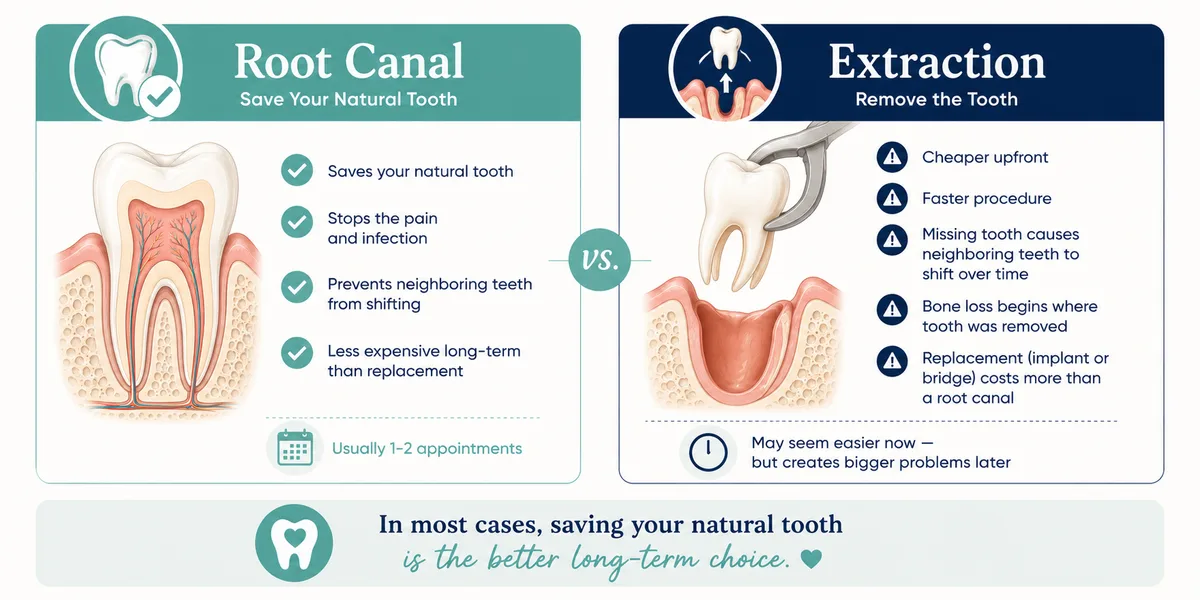
- When a tooth is infected or badly damaged, you usually choose to save it or remove it
- A root canal preserves your natural tooth and is almost always the better long-term option
- Extraction costs less upfront but leads to additional costs later if you want to replace the tooth
- An exam and X-rays are the only way to know which is right for your tooth
When a tooth is causing serious pain or has a bad infection, you want it fixed — fast. Two of the most common treatments for a damaged or infected tooth are a root canal and an extraction. Both solve the immediate problem. But they're very different paths forward. Here's what you need to know to make the right decision.
What Is a Root Canal?
A root canal removes the infected or damaged pulp — the soft tissue inside your tooth — cleans out the canal, and seals the tooth so infection can't return. After a root canal, most teeth are covered with a crown to protect them. The goal is to save your natural tooth. The tooth looks and functions normally after treatment. Most patients are surprised by how straightforward the procedure is — it's not nearly as bad as its reputation suggests. If you're nervous, our post on how a root canal actually feels walks through exactly what to expect.
What Is a Tooth Extraction?
An extraction removes the tooth entirely. Simple extractions are done in the office under local anesthesia. More complex cases — like impacted wisdom teeth — may require a surgical extraction. Extractions are faster and less expensive upfront. But removing a tooth creates a gap that affects how you chew, how neighboring teeth shift over time, and how your jawbone stays healthy.
Which Is Better?
In most cases, saving your natural tooth is the better choice. Here's why:
Your natural tooth is stronger. Nothing we put in your mouth works as well as your original tooth. The root, the bone around it, the sensation it gives you — all of that is preserved when we save the tooth.
Extraction leads to more decisions. Once a tooth is gone, you have to decide what to do about the gap. Options include a dental implant, a bridge, or a partial denture. Each has its own cost and process. A root canal avoids all of that.
Bone loss starts quickly. When a tooth is removed and not replaced, the jawbone in that area begins to shrink within months. Over time, this changes the shape of your face and makes future tooth replacement harder.
Long-term cost. A root canal plus a crown costs more upfront than an extraction. But if you replace an extracted tooth with an implant — which is the gold standard — you'll likely spend more in total than if you'd saved the tooth from the start.
When Extraction Makes More Sense
There are situations where extraction is the right call:
- The tooth is too damaged or decayed to be saved
- There isn't enough tooth structure remaining to support a crown after a root canal
- The infection has spread significantly and the prognosis is very poor
- The patient can't afford the full root canal and crown at this time and needs immediate pain relief
- Wisdom teeth that are impacted or causing problems
In these cases, extraction is a reasonable and sometimes necessary choice. Dr. Gegzna will be upfront with you about whether a tooth is worth saving.
Have questions about saving or removing a tooth? We're here to help.
Call (251) 308-0584 Book OnlineWhat About Cost?
A root canal plus a crown typically costs more upfront than a simple tooth extraction. However:
- If you extract and don't replace the tooth, you'll likely deal with shifting teeth and bone loss
- If you extract and replace with an implant later, the total cost is often higher than if you'd done the root canal and crown originally
- Many insurance plans cover a portion of both procedures
We'll go over your insurance benefits and treatment costs before anything is scheduled so you know exactly what you're looking at.
What Will Dr. Gegzna Recommend?
He'll look at your X-rays, assess the extent of the damage or infection, and give you his honest recommendation. If a tooth can be saved and it's in your best interest to save it, he'll tell you. If extraction is the smarter path forward, he'll tell you that too — along with your options for replacing it. We serve patients from Mobile, Theodore, Grand Bay, and the surrounding area.
Frequently Asked Questions About Root Canals and Extractions
Most patients are surprised to find root canals are no more uncomfortable than getting a filling. Modern anesthesia makes both procedures manageable. The pain you feel before treatment — from the infection — is usually much worse than the procedure itself.
Most root canals take one to two appointments, each lasting about an hour. After the root canal, you'll return for a crown, which takes a separate appointment.
The neighboring teeth will gradually shift toward the gap, and the jawbone in that area will begin to shrink. Over time, this can affect your bite, your appearance, and make future replacement more complicated and expensive.
Many PPO dental plans cover a portion of root canal treatment, typically at 50–80% after your deductible. We'll verify your benefits before your appointment so you know what to expect.

Dr. Joseph Gegzna, DMD is the founder and lead dentist at Rabbit Creek Dental in Mobile, Alabama. He earned his Doctor of Dental Medicine degree from the University of Louisville School of Dentistry and has been a licensed dentist in Alabama since 2014, with more than 12 years of experience in general, restorative, and implant dentistry. After several years practicing as an associate, he founded Rabbit Creek Dental in 2022 to build the kind of patient-first practice he believed in. He has completed advanced implant training through a 92-hour Implant Pathway program with live patient surgery and additional surgical training in impacted third molar extractions through the Koerner Center for Surgical Instruction. He is a member of the American Dental Association and is currently in his third year of the Bulletproof Dental Mastermind program, a continuing education group focused on delivering an exceptional patient experience. Before dentistry, Dr. Gegzna was a licensed pilot, bringing a calm, detail-oriented approach to patient care. Rabbit Creek Dental serves families throughout Mobile.
This article is for educational purposes only and does not constitute medical advice. For personalized guidance about your dental health, please contact our office at (251) 308-0584.