
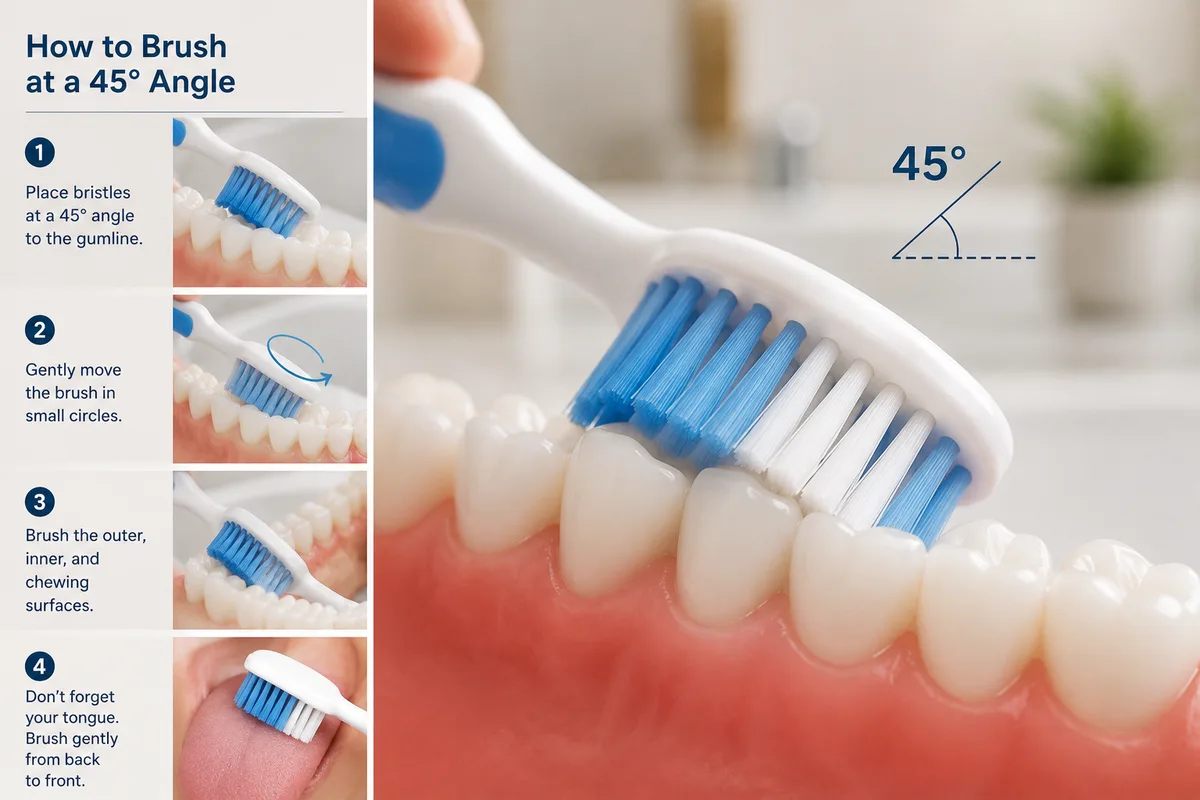
- Brush two full minutes, twice a day, with a soft-bristled brush and fluoride toothpaste
- Use small circular or gentle back-and-forth strokes — don't scrub
- Angle the brush slightly toward the gumline, and replace your brush every 3 months
- Most people brush too hard, too fast, or skip the gumline
Brushing feels automatic — you've been doing it since childhood. But most adults have at least one brushing habit that's either ineffective or actively harmful. Here's what dentists actually want you to know.
The Most Common Brushing Mistakes
Brushing too hard. This is the most damaging mistake. Aggressive scrubbing wears down enamel over time and causes gum recession — both permanent. Plaque is soft and doesn't require force to remove. If your brush bristles are splaying out within a few weeks, you're brushing too hard.
Not brushing long enough. The standard recommendation is two minutes, twice a day. Most people brush for 45–60 seconds. Set a timer once and see how long two minutes actually feels — most people are surprised.
Missing the gumline. This is where plaque accumulates and gum disease starts. Most people focus on the visible tooth surface and neglect the area where the tooth meets the gum. Angle your brush slightly toward the gumline (about 45 degrees) to clean this area.
Brushing immediately after acidic food or drink. Coffee, juice, soda, and citrus temporarily soften enamel. Brushing immediately afterward abrades the softened enamel. Wait 30 minutes, or rinse with water first.
Using a hard-bristled brush. Hard bristles don't clean better — they just cause more damage to enamel and gums. Soft bristles are the ADA recommendation for nearly all patients.
Not replacing the brush often enough. Worn bristles are less effective at removing plaque. Replace your toothbrush (or electric brush head) every 3 months, or sooner if the bristles are visibly frayed.
The Right Technique
Manual brush:
- Apply a pea-sized amount of fluoride toothpaste
- Hold the brush at about a 45-degree angle to the gumline
- Use short, gentle circular strokes or a back-and-forth motion — don't scrub
- Clean all surfaces: the outer surfaces, inner surfaces, and chewing surfaces of every tooth
- Brush for a full two minutes
- Gently brush your tongue to remove bacteria
Electric brush: Electric brushes do most of the work for you. Hold the brush at the gumline, move slowly from tooth to tooth, and let the brush do the motion. Don't scrub. Most quality electric brushes have a built-in two-minute timer.
Manual vs. Electric: Does It Matter?
Research consistently shows that electric toothbrushes — particularly oscillating-rotating models — remove more plaque and reduce gingivitis more effectively than manual brushing for most patients. That said, a manual brush used correctly is far better than an electric brush used incorrectly. Technique matters more than the tool. If you tend to brush too hard, an electric brush with a pressure sensor is worth the investment — it will alert you when you're applying too much force.
Fluoride Toothpaste: Non-Negotiable
Use fluoride toothpaste. Fluoride strengthens enamel and dramatically reduces cavity risk. The concentration in standard adult toothpaste (1,000–1,500 ppm) is safe and effective for daily use. "Natural" toothpastes without fluoride don't provide the same cavity protection. This isn't a preference — it's what the evidence shows. Good brushing is the foundation of good general dentistry, but it works best alongside professional care.
When to Brush
Twice a day: morning and before bed. Brushing before bed is the more important of the two — you want to remove the day's plaque before sleeping, when saliva flow decreases and bacteria have more time to act. Even with perfect brushing, plaque hardens into tartar that only regular cleanings can remove, which is why your hygienist is an essential part of the picture.
Do you really need to floss? → and Simple habits for a healthy smile →
We serve patients from Mobile, Theodore, Grand Bay, and the surrounding Gulf Coast area.
Frequently Asked Questions
Two minutes, twice a day. Most people brush for less than a minute. Set a timer until the habit is established.
For most people, yes — especially if you tend to brush too hard or too quickly. Electric brushes with pressure sensors and built-in timers remove more plaque and reduce the risk of gum recession from overbrushing.
Either works, with a caveat: if you eat acidic foods (citrus, juice, coffee), wait 30 minutes before brushing to avoid abrading acid-softened enamel. Brushing before breakfast avoids this issue entirely.
Fluoride toothpaste is the standard recommendation. Beyond that, choose based on your specific needs — sensitivity formulas, whitening, or enamel protection. Ask your hygienist what's appropriate for your situation.

Dr. Joseph Gegzna, DMD is the founder and lead dentist at Rabbit Creek Dental in Mobile, Alabama. He earned his Doctor of Dental Medicine degree from the University of Louisville School of Dentistry and has been a licensed dentist in Alabama since 2014, with more than 12 years of experience in general, restorative, and implant dentistry. After several years practicing as an associate, he founded Rabbit Creek Dental in 2022 to build the kind of patient-first practice he believed in. He has completed advanced implant training through a 92-hour Implant Pathway program with live patient surgery and additional surgical training in impacted third molar extractions through the Koerner Center for Surgical Instruction. He is a member of the American Dental Association and is currently in his third year of the Bulletproof Dental Mastermind program, a continuing education group focused on delivering an exceptional patient experience. Before dentistry, Dr. Gegzna was a licensed pilot, bringing a calm, detail-oriented approach to patient care. Rabbit Creek Dental serves families throughout Mobile.
This article is for educational purposes only and does not constitute medical advice. For personalized guidance about your dental health, please contact our office at (251) 308-0584.