
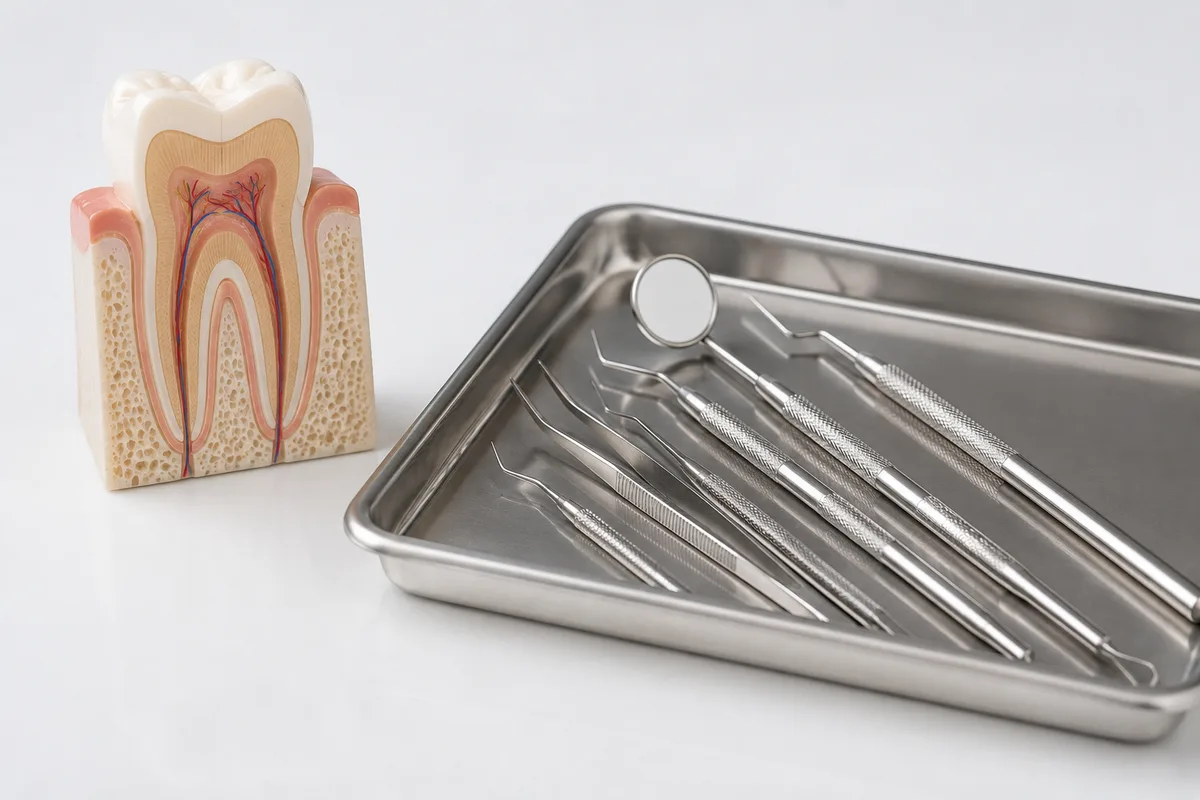
- Filling: For small-to-medium cavities (less than half the tooth width)
- Crown: For large cavities, broken teeth, after root canals, or when more than half the tooth is damaged
A filling patches a hole. A crown covers and protects the entire tooth. Your dentist will recommend either based on how much tooth structure remains.
When a patient has a cavity or a broken tooth, one of the most common questions they have is about the treatment.
"Dr. G, can you just put a filling in it, or am I going to need a crown?" It's a great question, and the answer depends on one key factor: how much healthy tooth structure is left.
My philosophy has always been to provide the most conservative treatment possible. I want to preserve your natural tooth for as long as I can. Think of it like repairing a wall in your house. If you have a small hole, you can patch it with a little spackle — that's your filling. But if the wall has a huge hole or is structurally unstable, you need to reinforce it with a new panel — that's your crown. Both are great repairs, but they are designed for different levels of damage.
What Is a Dental Filling?
A dental filling is a material that we use to fill a hole in a tooth after we've removed decay. It's a restorative treatment done directly in the mouth in a single visit.
When is a Filling the Right Choice?
A filling is the ideal choice for repairing minor to moderate damage, such as:
- Small to Medium-Sized Cavities: When tooth decay has created a relatively small hole, a filling is the standard of care.
- Minor Chips or Fractures: We can often use tooth-colored filling material (composite resin) to repair small chips on the edges of teeth.
The process is simple. We numb the area, remove the decayed portion of the tooth, and then place the filling material, shaping it to match the natural contours of your tooth. For tooth-colored fillings, we use a special light to harden the material, and then we polish it until it's smooth and comfortable.
Learn more about our approach to tooth-colored fillings.
What is a Dental Crown?
A dental crown, or "cap," is a much more substantial restoration. Instead of just patching a hole, a crown covers the entire visible portion of the tooth. It's custom-made in a dental lab to fit your tooth perfectly. Rabbit Creek Dental does not offer same-day crowns — lab-fabricated crowns offer better fit, strength, and longevity than chairside milling.
When is a Crown Necessary?
A crown is needed when a tooth is too damaged to be repaired with a simple filling. A filling relies on having enough healthy tooth structure around it to hold it in place. If the cavity or fracture is too large, a filling will act like a wedge and can actually cause the remaining tooth to break.
A crown is recommended in these situations:
- Large Cavities: If a cavity affects more than half the width of the tooth, a crown is usually needed to provide strength and prevent fracture.
- After a Root Canal: A tooth that has had a root canal is more brittle and prone to fracture. A crown is almost always placed on back teeth after a root canal to protect them.
- Severely Broken or Fractured Teeth: If a tooth has a large break or multiple fracture lines, a crown is needed to hold the tooth together and prevent it from splitting.
- Excessive Wear: If a tooth has been worn down due to grinding or acid erosion, a crown can restore its original shape and function.
- Cosmetic Enhancement: Crowns can also improve the appearance of a tooth that is misshapen or severely discolored.
See our dental crowns page for more on the crown process and what to expect.
Ready to schedule your visit?
An Honest, Patient-First Approach
As a dentist, my most important job is to be your trusted advisor. I will always take the time to explain your situation, show you your X-rays and pictures of your tooth, and then discuss the pros and cons of all your treatment options. My wife, Arlee, and I live right here in Tillman's Corner, and we treat our patients like the neighbors they are. You can trust that I will only recommend a crown when it is truly necessary for the long-term health and strength of your tooth.
My experience as a pilot and as a dental provider in Mobile, Alabama has reinforced my belief in doing things with integrity and precision. I won't recommend a crown just because it's a more extensive procedure. I'll recommend it because it's the right procedure to keep your tooth healthy and strong for years to come.
FAQ: Your Crown vs. Filling Questions
During the first visit, we prepare the tooth, take a precise intraoral scan, and place a temporary crown. The scan is sent to a dental laboratory where your custom crown is fabricated. At the second visit, about two weeks later, we remove the temporary and permanently cement your final crown.
Absolutely. If a tooth has a very large, old filling, it is often at high risk of fracturing. It is much better to proactively place a crown on a weak tooth than to wait for it to break, which could result in a more complex and costly repair, or even the loss of the tooth.
Pain is not always a good indicator of the structural integrity of a tooth. A tooth with a massive filling might feel fine, but it could be at risk of fracture. An X-ray and clinical exam will show us if the tooth is too weak to survive with just a filling.
Not always, but usually for back teeth. Front teeth that have had root canals can sometimes be restored with just a filling, as they don't bear as much chewing force. However, molars and premolars almost always need a crown after a root canal to prevent fracture.

Dr. Joseph Gegzna, DMD is the founder and lead dentist at Rabbit Creek Dental in Mobile, Alabama. He earned his Doctor of Dental Medicine degree from the University of Louisville School of Dentistry and has been a licensed dentist in Alabama since 2014, with more than 12 years of experience in general, restorative, and implant dentistry. After several years practicing as an associate, he founded Rabbit Creek Dental in 2022 to build the kind of patient-first practice he believed in. He has completed advanced implant training through a 92-hour Implant Pathway program with live patient surgery and additional surgical training in impacted third molar extractions through the Koerner Center for Surgical Instruction. He is a member of the American Dental Association and is currently in his third year of the Bulletproof Dental Mastermind program, a continuing education group focused on delivering an exceptional patient experience. Before dentistry, Dr. Gegzna was a licensed pilot, bringing a calm, detail-oriented approach to patient care. Rabbit Creek Dental serves families throughout Mobile.
This article is for educational purposes only and does not constitute medical advice. For personalized guidance about your dental health, please contact our office at (251) 308-0584.